
Font Size:


 We know your time is valuable. The drive-thru window at South Alabama Electric Cooperative’s main office in Troy lets you take care of business from the comfort and convenience of your vehicle. It’s just 1 of the quick and easy ways you can pay your bill.
There’s no need to get out in the sweltering heat or the pouring rain.
Pay your bill from the comfort of your car.
Plus, you still get top-notch customer service from our member service representatives, from left, Tanesha Whatley, Cheyenne Wallace, Deborah Carter, and Lea Jordan.
The drive-thru window is open Monday through Friday, from 8 a.m. to 5 p.m.
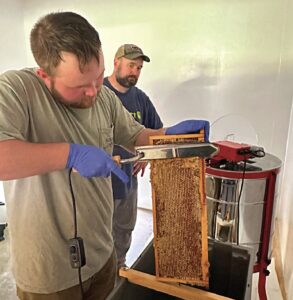
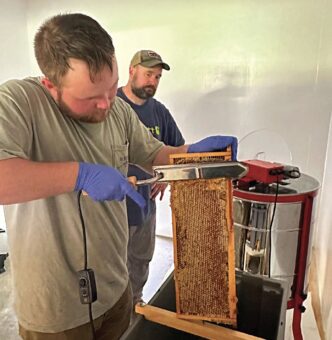
Unlike bees, Trey Ingram needs a refractometer to ensure the moisture content of his harvested honey is low enough to store it without spoiling.
While Ingram needs a tool to measure the moisture, bees intuitively fan their wings in hives until their honey has a perfect 17% to 18% moisture or humidity content before capping it with wax.
“They’re amazing creatures,” says Ingram, a certified journeyman beekeeper. He and his wife, Leigh, own Three’s Bees Apiary in Troy and have approximately 45 hives throughout Pike County. “We’ll be harvesting this year’s honey real soon and will have it out to the public as soon as possible,” he says.
During harvesting, Ingram generally only pulls a frame of honey if it is at least 90% capped. Otherwise, he runs the risk of the moisture content being too high, which can cause the honey to ferment and change its flavor.
The bees’ ability to determine humidity levels in honey is 1 of many examples of their remarkable precision. Another is the efficient hexagonal shape of the cells in a hive’s honeycomb, described by the ancient Greek mathematician Pappus of Alexandria as the bees’ “divine sense of symmetry.”
Ingram says his curiosity about bees and the decision the couple made 3 years ago to start an apiary opened a new chapter in his life. Nowadays, he represents beekeepers on a state agricultural committee, teaches classes to students and gardening groups, mentors other beekeepers, removes swarms, and provides hives to local farmers for pollination of their crops and flowers. He is also helping the Troy University Arboretum staff secure a grant for an observation hive and providing the Goshen High School Agricultural Center with startup hives for students to study.
“Honeybees have always fascinated me,” Ingram says.
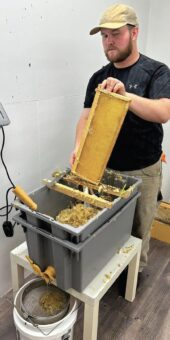
Ingram worked 20 years as a military police officer, with his last assignment as a military history instructor with the Auburn University Army ROTC. Anticipating his retirement, he decided to learn more about bees.
“There’s still so much we don’t understand about their behavior,” he says. “Considering they’re responsible for pollinating about 1/3 of the world’s food production, we have major concerns about preventing declines in their population.”
In the U.S., farmers rely on honeybees to pollinate fruit, nut, and vegetable crops.
Before Ingram retired, he and Leigh enrolled in a beekeeper program for veterans, Heroes to Hives. In April 2021, they completed the 9-month curriculum offered online by Michigan State University.
To continue learning about bees, Ingram worked as an intern and research technician at the Auburn University Bee Laboratory, helping care for 400 hives and learning about the latest research and treatment protocols to bolster the honeybee population.
“I’ve learned so much in the past few years,” says Ingram, who is currently working on his master beekeeper certification.
Wanting to share the health benefits of raw honey’s enzymes, vitamins, and nutrients, the Ingrams launched their family business, Three’s Bees Apiary, in 2022. 2 of the couple’s 3 sons, Barrett, 21, and Blake, 27, help with the work and enjoy learning about honeybees and what it takes to care for them.
Naming the business was easy, Ingram says, because the number 3 has so much personal significance. His full name is Earl Trey Ingram III. His high school nickname was Three.
“Besides, 3 is my lucky number, and it rhymes with bees,” he says.
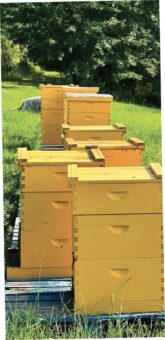
The Ingrams sell their honey at local farmers' markets and the downtown Troy seasonal markets, as well as a number of other Troy locations. The honey can also be found on the Three’s Bees Facebook page. The Ingrams hope to start raising queens and selling bees to help others become beekeepers.
While the family has hives in the yards of friends, the majority are located at a 60-acre farm owned by Ingram’s parents.
“They have plenty of resources in close proximity like privet, honeysuckle, blackberry, clover, elderberry, kudzu, Chinese tallow, goldenrod, and buckwheat,” he says. “That rich variety gives our honey its distinct flavor profile, making it a true taste of our local landscape.”
Ingram’s father planted 32 fruit trees on the farm, “so next year or so, we’ll start having orchard honey from apple, pear, peach, crabapple, and plum blossoms. We plan to have tulip poplar flower honey, too.”
Last December, Ingram was elected to the Alabama Farmers Federation State Bee and Honey Committee and will serve a 3-year term. He and Leigh also serve as ALFA’s bee and honey voting delegates for Pike County.
His nomination came about as a result of working at the Auburn lab, where he first met Richard Woodham, the South Region director of the Alabama Beekeepers Association. When an opening occurred on the bee committee, Woodham suggested Ingram submit his name so the region, and Pike County specifically, had better representation.
“State commodity committee members help direct policy for the state’s largest farm organizations like bee and honey production, allocate research dollars, and coordinate educational sessions for fellow farmers,” Ingram says.
When people ask him for advice about controlling varroa mites in hives, he refers to his experiences at the university lab.
“Every hive has mites,” he says. “It’s just a matter of the concentration. If you don’t control mites, you risk losing your hive. The mites live off bees’ fat.”
Ingram controls mites in his hives with applications of Apiguard, a slow-release thymol gel, as well as oxalic acid, which is found naturally in plants.
To control small hive beetles, he lays down dry, unscented household duster sheets.
“The sheets function as a trap and the bees push the beetles toward the sheets,” he says. “Placing a hive in direct sun will discourage beetles, too.”
During the winter, Ingram gives his bees a break.
“Some people harvest too much honey, then have to feed them during winter,” he says. “I let them have the season off. I run double brood boxes, so the top box has enough honey in it for them to feed on.”


I would like to write this month about attitude, specifically, my attitude. This summer, I was traveling across our wonderful country when a criminal broke into my vehicle and stole my checkbooks, camera, and approximately a dozen SD cards from my camera bag.
I immediately took steps to protect my bank accounts, but those SD cards were priceless because they contained pictures from past vacations and family events over several years. The criminal obviously did not care about our personal treasure on those cards, and we cannot get those moments back.
As you can probably guess, my attitude shifted from joy to grumbling about how unlucky I am and why this would happen to me. After getting the window repaired and cleaning the glass from inside the vehicle, we continued our trip. Soon, my attitude turned around, realizing that the incident could have been much worse and only set us back by about 4 hours.
Life is always going to happen. Philippians 4:4 states, “Rejoice in the Lord always. I say again: Rejoice!” When we can rise above life’s circumstances, we see things from a different perspective, and it shows in our attitude.
How is your attitude toward your electric cooperative these days? Over the past year, South Alabama Electric Cooperative (SAEC) has been forced to make some changes to how we do business. There have been hiccups, from issues with members receiving their monthly bills on time to the cooperative receiving payments effectively. I have tried to apply Philippians 2:14 to these situations. “Do everything without grumbling or arguing.” I failed this verse under the theft situation, but I tried!
So, how are we trying to fix this issue? The speed of light is faster than tires on the road, so we are strongly encouraging all of our members to receive their bills via email. We call this an e-bill or going paperless.
This is how it works: When the cooperative creates a billing file to be printed and snail-mailed to you, the members who have signed up for e-billing will get an email letting them know that their bill is ready. From there, members can log in to their SAEC account and view their bill. The digital version is “identical” to the bill you would receive in the mail, but about 2 weeks faster.
Why would your cooperative want you to go paperless? For one, it saves money on mailing costs. But, as electric bills continue to rise, it also guarantees you will receive your bill on time, giving you more time to prepare payment.
There are also other benefits to setting up an online account. Each year, between the end of January and April 15, we get an uptick in calls from members wanting to know how much they paid in the past year. It is the time of year that we all love. No, not football season or deer season. It’s tax time!
With an online account, this information is only a click away and available to all members, no matter how your bill is delivered to you. Even without signing up for e-billing, we can set up a text notification letting you know that your e-bill is ready to be viewed online about 12 days before it is due. This function provides you access to your electric bill, just in case the mail service loses or is late with your bill.
If you choose regular mail and don't receive your bill, please log in to see the bill online. It is just a few clicks away. And always remember Philippians 2:14: Don’t grumble about change, but rejoice because change can be good.
If you have any questions, our member service representatives will be happy to walk you through the process. Thank you for your positive attitude toward your cooperative, and I promise to continue working on my own.


High school students from all over the country represented local electric cooperatives during this year’s National Youth Tour in Washington, D.C.
The 2 delegates selected by South Alabama Electric Cooperative — Lola Drinkwater and Cade May — joined hundreds of their peers to visit historic sites and museums, receive a glimpse of how the federal government functions, and how their local cooperative works for their communities.
“It was a great trip,” says May, a 17-year-old from Banks who attends Pike Liberal Arts School. “I got to meet a lot of great people. Honestly, what was probably my favorite part was getting to meet everybody there. I made a lot of friends with people from all over the state.”
Drinkwater, 17, a resident of Troy and a student at Charles Henderson High School, also enjoyed making new friends through the experience.
“We had good counselors and good tour guides,” she says. “I made a lot of new friends from Alabama and from other states, which was interesting to get to interact with people from other states.”
National Rural Electric Cooperative Association sponsors the annual Youth Tour each June. The event dates back to the late 1950s and now includes more than 1,500 students and over 250 chaperones.
The Alabama Rural Electric Association hosts a statewide Youth Tour earlier in the year, with high school juniors selected to attend by local cooperatives such as SAEC.
Along with learning how elected officials work to pass legislation and visiting the museums, May says his favorite moment was a parade at the Marine Barracks, featuring “The President’s Own” U.S. Marine Band, “The Commandant’s Own” U.S. Marine Drum and Bugle Corps, and the U.S. Marine Corps Silent Drill Platoon. May was impressed by the skill of the musicians as well as the synchronized movements and rifle handling by the silent drill platoon.
“It just showed me how well-trained they are and how much time and effort they put into what they do,” May says.
During the visits to museums, Drinkwater enjoyed discovering American history that isn’t discussed as much. The trip to the Holocaust Museum was one she won’t forget any time soon.
“It was an emotional experience, and it was really eye-opening and provided a deeper understanding,” she says.
Drinkwater says she’s glad she applied for Youth Tour and encourages other students to do the same when the time comes.
“It’s a great experience, and it was really worth all the walking around and being tired,” she says. “It’s really a once-in-a-lifetime experience for all the things that we got to go do.”
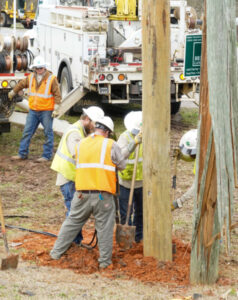
 Do you know how to react if your vehicle strikes a power pole? What should you do if you come upon an accident that involves a vehicle colliding with a pole?
South Alabama Electric Cooperative has seen its share of poles damaged by vehicle collisions. Accidents happen, and we want to make sure our members know how to stay safe in such situations.
When a vehicle hits a utility pole, the pole could split or fall. Power lines could end up draped across the vehicle or on the ground nearby, causing the area around the vehicle to become charged with energy. Anyone stepping within the area could be electrocuted.
Follow these tips to stay safe:
Have you ever had someone fully believe in you?
Most of us can answer that question with mom or dad. Maybe a grandparent. I’m asking about outside of your family — a teacher, a coach, or someone you work with. I have been blessed to have several people outside my family believe in me.
Do you know how I know Douglas Green believed in me? He told me.
He also told me he loved me. I think it’s rare for men to express their feelings and to encourage others. That did not stop Mr. Green.
On June 10, 2025, I lost my true believer, and cooperative members lost a true advocate. Mr. Green served South Alabama Electric Cooperative for 41 years, never losing focus on who he was there to serve — the members.
At the beginning of the 32 years I knew Mr. Green, I wasn’t sure how to take him because he was always picking on me. Even after I became the general manager, he would tell wild stories about me at employee functions for all to hear. By then, I knew if Mr. Green picked on you, he liked you. Every time he saw my wife, Nelda, he joked about what a good job she did writing my monthly articles. She would respond and say, “No, he writes them.” He would reply, “You don’t have to cover for him.”
Mr. Green was a special person. He was a special leader with a talent to apply common sense to leading young people and a large corporation like South Alabama.
Mr. Green, an educator and principal at Zion Chapel School, had a wonderful approach to giving young people a second chance. If a student got in trouble, he would write the child’s offenses on a piece of paper. He told these students if they never returned to his office for a disciplinary matter, he would not tell their parents and would destroy their files after they’d finished school.
If the student kept their promise, Mr. Green kept his promise.
Mr. Green applied that common-sense approach in the boardroom. I saw him take complex issues and bring management and other trustees to a simple solution that was always fair to the cooperative and its members.
As much as I admired Mr. Green’s problem-solving and leadership abilities, what I regarded in him most was his faith. The trials Mr. Green faced could only be supported by a strong faith in God. Mr. Green was married 3 times. Each one of his wives preceded him in death. He was blessed with 2 children, Larry and Karen. Mr. Green buried his only daughter and watched his son battle cancer. These challenges are not easy to navigate even with strong faith, but Mr. Green leaned on his faith in Jesus Christ hard and was able to show how Jesus Christ carries you during your worst trials. When Mr. Green prayed, it was like he was having a conversation with Jesus.
Today, I know he is having a face-to-face conversation with his Lord. I say that not to comfort his family, friends, or myself. I make that statement because his presence with the Lord is a fact.
It’s difficult to move forward without a man who truly believed in me. But, as I learned from him, I will lean on my faith to get me through losing Norman Douglas Green.
As I looked down at Mr. Green at his funeral, he cracked me up one last time. In our South Alabama Electric headquarters building, you need a security badge to enter the office. Mr. Green often lost or forgot his security badge. But as I looked down at him, he was wearing his South Alabama Electric Cooperative security badge, and I just smiled. He no longer needs that security badge because he already had his heavenly security badge laminated years ago.
I will see you later, Mr. Green. Thank you for being a true believer in me.

 With 4 major hurricanes forecast for the 2025 Atlantic hurricane season, forecasters advise residents to be prepared as the season’s peak approaches.
9 hurricanes are predicted for this year’s Atlantic basin hurricane season, which began on June 1 and extends through November 30, with 4 of those possibly becoming major storms, according to forecasters at Colorado State University’s Tropical Meteorological Project. Mid-August to mid-October is considered the peak time for storm development.
Forecasters encourage people to stay informed about storm alerts and ongoing developments. Use apps or television forecasts with information provided by the National Weather Service or your county’s emergency management agency.
Check off items on a list and consolidate them in an easily accessible place to ensure you are ready if a storm develops that impacts your area.
At the top of a preparedness list is water, 1 gallon per person per day, according to the Alabama Department of Public Health’s recommendations. Next, a 2-week supply of nonperishable food per person, along with a manual can opener, is suggested.
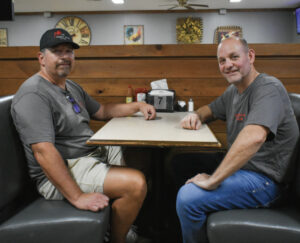
Winning Bama’s Best Fried Chicken contest triggered unimaginable and fortuitous chain reactions for owners of the Chicken Shack in Luverne.
Michael and Drew Money, brothers who have been making their eatery’s signature entree since they were teens, have had to double their weekly poultry order to satisfy a growing number of loyal customers’ cravings.
“Now we order 4,000 pounds of chicken a week,” Michael says. “We get shipments of fresh chicken every other day.”
Since 2018, when the brothers won a contest sponsored by “Simply Southern TV,” they have been featured on other television shows and have won more contests. The Chicken Shack Facebook page has more than 6,000 followers.
While adjusting to those changes, the brothers took care to keep the core of the business unchanged since it opened in 1968 at 665 South Forest Avenue, just off U.S. Highway 331.
“We still order our chicken from the same supplier in Union Springs that the original owners used,” Michael says. “Our recipes for the brine marinade and bread coating haven’t changed either and are made for us locally.”
On social media, reviewers rave about the chicken’s characteristically crunchy outside while the meat remains moist and juicy inside.
“The secret to keeping it moist is our brine marinade,” Michael says. “We cut and trim chicken daily and put it in the marinade every afternoon so it’s ready for the next day.”
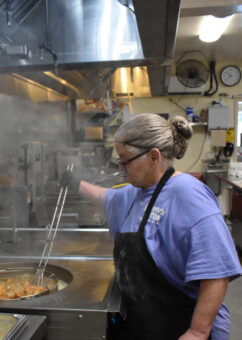
To fry it quickly, they plunge it into 350-degree beef tallow for about 17 minutes.
“We switched from highly processed seed oil to beef tallow because some new nutrition studies found that it’s healthier,” Michael says.
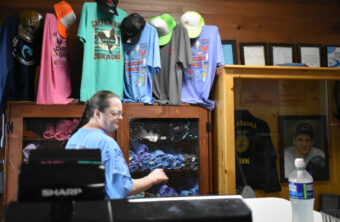
The wall surrounding the restaurant’s register displays the Chicken Shack’s culinary accomplishments with framed certificates and plaques for winning contests.
“The ‘Simply Southern’ contest was the first one we won, so we qualified for others and have done well,” Drew says.
Hearing about the Chicken Shack through social media, curious crews with WSFA-TV, the NBC affiliate in Montgomery, came to see for themselves and to feature the restaurant on their broadcasts.
“They’ve been here several times,” Drew says. “The word has gotten out. A lot of people stop on their way to the beach and tell us that eating here has become part of their vacation tradition. We’re very appreciative.”
Working at the Chicken Shack is a family tradition for the brothers. Their father, Henry, was known for his expertise managing restaurants, so original owners Nick and Dot Nichols hired him to run it in 1973. Eventually, the Nicholses sold the restaurant to Henry.
“This place has been part of our lives since we were teenagers,” Michael says. “I started here when I was 15, and now I’m 52. My wife and our 2 children work here, too.”
In 2013, Michael bought the business. The brothers rotate shifts, working every 2 days to give each other some time off, arriving an hour before it opens at 8:30 a.m.
“We do it all from cutting to cooking,” Drew says.
While keeping the mainstays on the menu — chicken, hamburgers, hot dogs, coleslaw, and fries — the brothers have expanded to offer seafood, several side dishes, and desserts from Dean’s Cake House.
They have made a few changes in their business model. “For some people who don’t want fried food, we offer grilled pork, chicken, and shrimp in the evenings,” Michael says. “6 years ago, we began offering online ordering, too.”
Summer is the busiest time of year with vacationers and locals filling the dining room’s seating capacity of 130. Their private banquet room accommodates 35 to 40.
The brothers reminisce about the business’s origins. The original building, a small red brick structure, stood at the south end of the parking lot.
“I wish we had a photo of it,” Michael says. “The business grew so much that this building was constructed.”
They attribute the growth to their customer service, catering, and father’s perfectionism. Henry owned and worked at the shack for 40 years and made it the community’s beloved destination for civic events, company dinners, birthday celebrations, and other milestones for almost everyone in town.
The brothers are equally committed to the community, offering discounts to schools and other nonprofits and sponsoring ball teams and supporting Christmas singing.
“Like Dad and the 2 of us, our kids are devoted to keeping the business going,” Michael says.
The Chicken Shack is open daily at 8:30 a.m. and closes at 9 p.m., except Friday and Saturday when it closes at 10 p.m.


Troy University’s Alpha Tau Omega fraternity brothers set a record this year by raising $140,000 with their fundraiser supporting wounded veterans.
During the philanthropic effort, called Walk Hard, a group of 35 fraternity brothers spent their spring break walking from the university’s quad to Panama City Beach, Florida, over the span of 6 days.
The 128.3-mile trek raises money for Jeep Sullivan’s Wounded Warrior Outdoor Adventures, based in Bonifay, Florida. The organization sponsors hunting and fishing outings for veterans, military personnel wounded in combat, and their families. Since its start, Walk Hard has raised nearly $900,000 for the charity. This year’s amount was $15,000 more than the fraternity’s previous record, set in 2023.
This is the 15th year Alpha Tau Omega members have done the fundraising walk. From Troy, walkers journey down Highway 167 through Enterprise and Hartford before crossing the Florida state line. They travel through Esto, Bonifay, Vernon, and Ebro along Florida Highway 79 before reaching Panama City Beach and ending at Pier Park.

This year’s event included 14 brothers who were walking for the first time, 19 walking for their second or third trip, and 2 who walked all 4 years of their time at Troy University.
Along with walkers, other fraternity members serve in 3 support teams to help along the way, says Alpha Tau Omega member James Strickland, the 2025 Walk Hard event director. More fraternity members gather at the walk’s designated end to support those who walked.
Strickland walked his freshman and sophomore years before stepping into the assistant director role last year. He says fraternity members bond over the shared experience.
“Obviously, it’s luck of the draw when it comes to blisters, muscle soreness, and knee pain,” Strickland says. “But everybody’s whining together, crying together, hurting, but having a good time. It’s a great source of memory making, bond building.”