
Font Size:

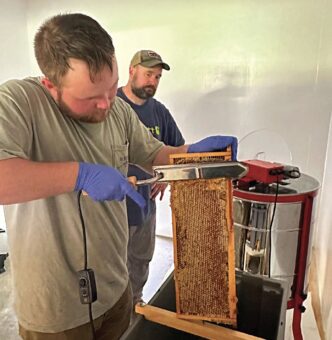
Unlike bees, Trey Ingram needs a refractometer to ensure the moisture content of his harvested honey is low enough to store it without spoiling.
While Ingram needs a tool to measure the moisture, bees intuitively fan their wings in hives until their honey has a perfect 17% to 18% moisture or humidity content before capping it with wax.
“They’re amazing creatures,” says Ingram, a certified journeyman beekeeper. He and his wife, Leigh, own Three’s Bees Apiary in Troy and have approximately 45 hives throughout Pike County. “We’ll be harvesting this year’s honey real soon and will have it out to the public as soon as possible,” he says.
During harvesting, Ingram generally only pulls a frame of honey if it is at least 90% capped. Otherwise, he runs the risk of the moisture content being too high, which can cause the honey to ferment and change its flavor.
The bees’ ability to determine humidity levels in honey is 1 of many examples of their remarkable precision. Another is the efficient hexagonal shape of the cells in a hive’s honeycomb, described by the ancient Greek mathematician Pappus of Alexandria as the bees’ “divine sense of symmetry.”
Ingram says his curiosity about bees and the decision the couple made 3 years ago to start an apiary opened a new chapter in his life. Nowadays, he represents beekeepers on a state agricultural committee, teaches classes to students and gardening groups, mentors other beekeepers, removes swarms, and provides hives to local farmers for pollination of their crops and flowers. He is also helping the Troy University Arboretum staff secure a grant for an observation hive and providing the Goshen High School Agricultural Center with startup hives for students to study.
“Honeybees have always fascinated me,” Ingram says.
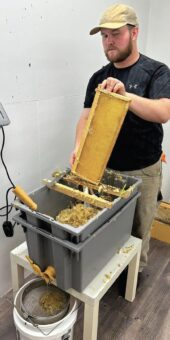
Ingram worked 20 years as a military police officer, with his last assignment as a military history instructor with the Auburn University Army ROTC. Anticipating his retirement, he decided to learn more about bees.
“There’s still so much we don’t understand about their behavior,” he says. “Considering they’re responsible for pollinating about 1/3 of the world’s food production, we have major concerns about preventing declines in their population.”
In the U.S., farmers rely on honeybees to pollinate fruit, nut, and vegetable crops.
Before Ingram retired, he and Leigh enrolled in a beekeeper program for veterans, Heroes to Hives. In April 2021, they completed the 9-month curriculum offered online by Michigan State University.
To continue learning about bees, Ingram worked as an intern and research technician at the Auburn University Bee Laboratory, helping care for 400 hives and learning about the latest research and treatment protocols to bolster the honeybee population.
“I’ve learned so much in the past few years,” says Ingram, who is currently working on his master beekeeper certification.
Wanting to share the health benefits of raw honey’s enzymes, vitamins, and nutrients, the Ingrams launched their family business, Three’s Bees Apiary, in 2022. 2 of the couple’s 3 sons, Barrett, 21, and Blake, 27, help with the work and enjoy learning about honeybees and what it takes to care for them.
Naming the business was easy, Ingram says, because the number 3 has so much personal significance. His full name is Earl Trey Ingram III. His high school nickname was Three.
“Besides, 3 is my lucky number, and it rhymes with bees,” he says.
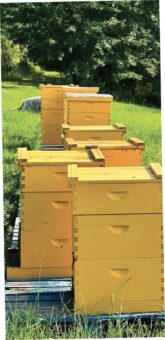
The Ingrams sell their honey at local farmers’ markets and the downtown Troy seasonal markets, as well as a number of other Troy locations. The honey can also be found on the Three’s Bees Facebook page. The Ingrams hope to start raising queens and selling bees to help others become beekeepers.
While the family has hives in the yards of friends, the majority are located at a 60-acre farm owned by Ingram’s parents.
“They have plenty of resources in close proximity like privet, honeysuckle, blackberry, clover, elderberry, kudzu, Chinese tallow, goldenrod, and buckwheat,” he says. “That rich variety gives our honey its distinct flavor profile, making it a true taste of our local landscape.”
Ingram’s father planted 32 fruit trees on the farm, “so next year or so, we’ll start having orchard honey from apple, pear, peach, crabapple, and plum blossoms. We plan to have tulip poplar flower honey, too.”
Last December, Ingram was elected to the Alabama Farmers Federation State Bee and Honey Committee and will serve a 3-year term. He and Leigh also serve as ALFA’s bee and honey voting delegates for Pike County.
His nomination came about as a result of working at the Auburn lab, where he first met Richard Woodham, the South Region director of the Alabama Beekeepers Association. When an opening occurred on the bee committee, Woodham suggested Ingram submit his name so the region, and Pike County specifically, had better representation.
“State commodity committee members help direct policy for the state’s largest farm organizations like bee and honey production, allocate research dollars, and coordinate educational sessions for fellow farmers,” Ingram says.
When people ask him for advice about controlling varroa mites in hives, he refers to his experiences at the university lab.
“Every hive has mites,” he says. “It’s just a matter of the concentration. If you don’t control mites, you risk losing your hive. The mites live off bees’ fat.”
Ingram controls mites in his hives with applications of Apiguard, a slow-release thymol gel, as well as oxalic acid, which is found naturally in plants.
To control small hive beetles, he lays down dry, unscented household duster sheets.
“The sheets function as a trap and the bees push the beetles toward the sheets,” he says. “Placing a hive in direct sun will discourage beetles, too.”
During the winter, Ingram gives his bees a break.
“Some people harvest too much honey, then have to feed them during winter,” he says. “I let them have the season off. I run double brood boxes, so the top box has enough honey in it for them to feed on.”