Font Size:


 Power outages happen. When they do, it is important to know how safe your food is, especially during summer thunderstorms and peak hurricane season.
According to the United States Department of Agriculture’s Food Safety and Inspection Service and the Centers for Disease Control and Prevention, food safety during power outages depends on several factors. Here is what you need to know:


The Miracle League is no ordinary baseball league, and the field used by its athletes is no ordinary playing surface.
Based in Conyers, Georgia, the Miracle League allows special needs children and adults to play baseball on custom fields with a rubberized surface to accommodate wheelchairs and players with physical challenges. Volunteers who serve as “buddies” play alongside the league’s athletes.
Shelia Compton, president of the Troy Miracle League, says something as simple as playing baseball means so much to Miracle League athletes. As a parent of an athlete, Compton says seeing them socializing with people who accept them is a blessing for their families.
“It means so much every year to see new players have that experience of being able to physically be involved in a sport that they only get to watch other people play,” she says. “It gives them a moment of feeling like they’re totally like everyone else and that they don’t have challenges to overcome.”
The Troy Miracle League Field opened in 2011 at the Troy Sportsplex. The green and brown field is now worn and there are gaps in the seams of the playing surface creating hazards for the athletes.
South Alabama Electric Cooperative decided to help by giving $5,000 to the field restoration project, along with another $5,000 pledged by PowerSouth Energy Cooperative in Andalusia. On top of those donations, SAEC submitted the project to 1 of its 3rd-party lenders, CoBank, which kicked in an additional $5,000 through its charitable matching program, bringing the total contribution to $15,000.
SAEC and PowerSouth were among the initial donors when the field was built. The local Miracle League holds a special place for SAEC General Manager David Bailey. His grandson, Kristian Prettyman, is visually impaired and a Miracle League athlete. Bailey says he hopes SAEC will be able to budget more donations for the field project.
“We’re community-minded — 1 of our 7 principles we have as a cooperative — but for me, it’s a little more personal,” Bailey says.

The Troy Miracle League has been raising money to cover the estimated $200,000 price tag to resurface the playing field by selling T-shirts for $20 each and seeking donations from supporters, Compton says. The league is nearly halfway to its goal.
If all goes well, Compton says the league hopes work can begin following this fall’s kickball season and be completed prior to the spring 2025 baseball season.
To donate to the Troy Miracle League’s field project, mail checks, payable to the Miracle League Foundation of Troy, to P.O. Box 504, Troy, AL 36081. Donations can also be made at Troy City Hall or Troy Parks and Recreation.
The league plays each Tuesday during its seasons. For more information, visit the Miracle League of Troy’s Facebook page.


Curious about how the weather can affect the amount of energy produced by a solar facility? Wondering what happens when the sun is not shining?
Now you can find answers to those questions, track trends and learn about weather impacts for the Wing Solar facility through South Alabama Electric Cooperative’s website. A link to the solar dashboard is available at southaec.com. Simply scroll to the bottom of the homepage to the custom link for Wing Solar or click on Energy Savings in the navigation bar at the top of the homepage, and then click on Wing Solar.
Located on a 986-acre site in Covington County, Wing Solar is a collaboration between PowerSouth Energy Cooperative and Origis Energy. PowerSouth, headquartered in Andalusia, provides wholesale power to 16 electric cooperatives, including SAEC, and 4 municipal electric systems in Alabama and Northwest Florida. Power-South relies on a mix of sources for power generation — natural gas, hydroelectricity, nuclear, coal, and solar.
The 80-megawatt Wing Solar facility began operation in 2023 to supply PowerSouth’s members with renewable, solar-generated energy and the potential to power 13,000 homes annually. Cloud cover, time of day, and even temperature can impact the facility’s actual output, however.
The Wing Solar dashboard lets members see the megawatts produced at various times. For example, a visitor to the website can look at the current date’s solar generation or select another day with the dashboard calendar. A line chart shows how energy generation peaks throughout the chosen day. Bar graphs show members the solar energy generation levels by week and month.
The dashboard also provides the current temperature and the percentage of cloud cover with a gauge showing the current megawatt production at the facility, which harnesses energy from more than 230,000 solar panels. The solar dashboard also shows the facility’s total generation in megawatt hours for the current day, month and year to date.


Her instructor allowed her to take the controls during a flight from Troy to Andalusia. “She let me get a feel for the plane. I think it’s kind of surreal just being in control of an airplane the very first time, especially not being around it very much before that.”
When Hurst finishes her training and earns her private pilot’s license, she will be the 11th student to do so through Pike County School System’s First in Flight and Leadership Academy. Through the program, Hurst earned both her high school diploma and an associate degree from Troy University when she graduated in May.
The dual enrollment program has given her much more than just her diplomas, she says.
“I’ve realized that I can handle a lot more than just school and work,” Hurst says. “I can go to school and flight train and do all the things. I realized that I’m capable of a lot more than I thought I was.”

Pike County Schools’ Center for Advanced Academics and Accelerated Learning started offering innovative dual enrollment programs in 2014. They provide the opportunity for high school students to earn associate degrees through partnerships with postsecondary schools like Troy University and Enterprise State Community College.
Along with the First in Flight and Leadership program, there are academies for everything from agriscience to electrical engineering, medical-assistant technology, and paralegal studies. There are also programs for short-term certificates in fields like aviation maintenance, information technology security, and 3D manufacturing.
The school district covers all costs of the academy programs. Jeff McClure, administrative assistant to the superintendent, oversees the dual enrollment programs and says they have a rigorous selection process.
Students can apply in the ninth grade, writing an essay explaining why they are a good candidate. Applicants must have a minimum grade point average of 3.0 and the necessary ACT or English and math placement scores. Along with those requirements, they also need recommendations from an administrator and 3 teachers.
The number of prospective academy students fluctuates each year with a record 100 applications under consideration for the upcoming school year. As the programs have grown, more out-of-zone students—like Hurst, who lives in Brantley in Crenshaw County—have been willing to pay tuition fees in order to attend 1 of the academies offered by Pike County Schools.

Mechatronics and exercise and health programs are among the most popular associate degree programs. Interest has also been growing in international studies, McClure says. The academy-specific elective courses are key to hooking 16- and 17-year-olds, he says.
“What makes it specific to their academy are the elective courses that are paired with those general studies,” he says. “The purpose of that is to find what makes those students come alive, because if I want to do something that’s exciting and I’m doing something that’s boring, no matter how gifted I am, I’m not going to excel at it because I’m just not going to find interest in it.”

First in Flight and Leadership is among the smallest programs as far as the number of participants, but it is 1 of the more expensive programs for the school system to provide. Of the 150 students enrolled in the dual enrollment programs during the 2024 school year, only 2—Hurst and 1 other student—were enrolled in the First in Flight and Leadership program. 10 students have received their private pilot licenses since 2014, and 2 have completed instrument training.
Flight academy students typically begin flight instruction during their junior year, although that may vary depending on the student, McClure says. The attrition rate is high for the First in Flight program, as students often discover piloting is not for them. The school system then will move those participants into another academy.
Students fly out of Troy Municipal Airport with First in Flight instructor pilots from SkyWarrior Flight Training in Pensacola, Florida. Instructor pilot Braidy Terry says weather and other issues can delay licensing, especially when students still need to log the required solo flights and test with Federal Aviation Administration pilot examiners. A student pilot must be 17 years old to earn a private license.

Hurst has never flown on a commercial airplane. Prior to flying the Cessna 172 airplanes used for her training, she had only flown with her mother, Ashley Atwell, who was training for her own pilot’s license at the time and is now a flight instructor at Enterprise.
As a student logging flight time, Hurst flew up to 3 times during the school week and on weekends, if possible. Once she has her license, she wants to be a private pilot for a company or an individual.
The joy Hurst felt during that first flight remains with her.
“I feel like most of the time you either love it or you hate it, and I love it,” Hurst says. “There’s not much in between. Most people don’t feel mediocre about it.”

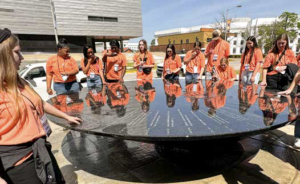

Each year, high school juniors representing Alabama’s electric cooperatives converge on Montgomery for a chance to learn leadership skills, see how their government works and make connections with peers from around the state.
The Alabama Rural Electric Association hosts the Montgomery Youth Tour, and around 150 students made the journey to the state’s capital March 13-15. South Alabama Electric Cooperative sent 14 students to the 2024 youth tour.
While in Montgomery, students learned how cooperatives work, spoke with elected officials, toured historic sites and participated in leadership and team-building activities.
To be chosen to participate in the tour, students from local high schools within SAEC’s service areas in Pike, Coffee and Crenshaw counties apply, write an essay and are interviewed. From those teens selected to travel to Montgomery, SAEC chooses 2 students to also attend the National Rural Electric Youth Tour in Washington, D.C., in June.
Joy Schwarte and Savannah Edgar will represent SAEC in Washington, D.C. The high school juniors said the trip to Montgomery showed them what they could do in the future if they work with others to better their home state and their communities.
“We just connected because we were all there for the same reason, to grow as leaders,” says Schwarte, 17, who attends Pike Liberal Arts School.
Edgar, 16, attends Highland Home High School and says the roster of guest speakers featured during the Montgomery Youth Tour resonated with her, especially one speaker’s message of how life never really goes according to plan.
“I’ve had so many ups and downs, and if I looked at myself in ninth grade and where I am now, I would have never been able to imagine myself here,” Edgar says.
Schwarte says the speakers emphasized the need to think “outside the box” to solve problems. “You have to be flexible, and you have to learn to compromise,” she says.
Along with hearing from motivational speakers, while they were in Montgomery students participated in games designed to teach them how cooperatives work and about financial literacy and teamwork.
Learning how the state and federal governments can impact the daily lives of individuals was eye-opening, Schwarte says. Also, she says she learned how SAEC betters the communities it serves in ways other than providing electricity, and it made her realize the importance of individuals helping their communities.
“I want to be a mechanical engineer, and I wanted to do that before this and I still want to do that now,” Schwarte says. “But I think this has helped me realize that it takes so many people to make something great work. It’s not just by yourself, and so I want to be part of a team now when I grow up not just to do something I like but something that’s going to impact a community.”
Edgar says the experience makes her think twice about leaving her home state once she has completed her education.
“Being from a small town, I’ve always kind of just wanted to get out,” she says. “Going on this trip and hearing all the amazing things about Alabama, I’ve come to realize I really love my home and my community and how it’s affected me growing up. I just want to be able to give back to that.”
Nearly 60 Alabama students will go to Washington, D.C., for the weeklong National Rural Electric Youth Tour, joining more than 1,800 students from across the nation. The National Rural Electric Cooperative Association, the Alabama Rural Electric Association and local electric cooperatives sponsor the national youth tour.

The youth tour engages young people who want to learn through experiences outside of the classroom.
“You’re creating the leaders of tomorrow,” says SAEC Vice President of Member Services Andy Kimbro. “They get to interact with other like-minded students wanting to be leaders, wanting to make things better in their community. Some of them do this and do not really understand the magnitude of how it is going to affect them.”
Kimbro hopes the experience will give students a better understanding of electric cooperatives as a business model, the issues faced by cooperatives, how cooperatives deliver electricity and the cost behind it.
“It is a great opportunity, the way we see it, to educate those students on what a cooperative is but also how to be a better citizen for the community that you live in,” he says.
Today’s young people are often seen as disconnected from the real world, but Kimbro says the students involved in the youth tour never fail to impress with their desire to learn.
“By the time they are finished, they come out with a new energy,” Kimbro says. “They want to make a difference.”
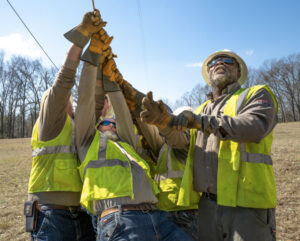

It is hard to forget that first climb. Even linemen with decades of experience under their belts clearly remember the details of their first trip up a pole.
“It’s one of those things when you get used to it, it’s not too bad,” says Dylan Mobley, who has been a lineman with South Alabama Electric Cooperative for 10 years. “When you get to doing it every day, you get comfortable with yourself and trust in yourself.”
April is Lineman Appreciation Month, and April 18 is National Lineman Appreciation Day. Over the years, the linemen with SAEC have seen changes in their field in the areas of safety, training, equipment and technology. With those changes, linemen have evolved to meet the needs of members.
Even the journey up the pole is different. Foreman Dewayne McGhee joined SAEC 34 years ago, starting out on the ground crew and training to become a lineman. Throughout his career McGhee saw technology advance with service maps now as readily available as a computer tablet. The tools linemen carry around on their trucks also improved over the years, making work more efficient.
“As the times change, everything else changes,” McGhee says.
When you get to doing it every day, you get comfortable with yourself and trust in yourself.” — Dylan Mobley, South Alabama Electric Cooperative lineman
For example, how linemen are trained today is notably different than in years past. General Foreman Chris Sanders started with SAEC 39 years ago and worked his way up to journey lineman, the highest classification. Sanders says specialized lineman schools have brought a substantial change in the industry. Sanders and McGhee both learned as apprentices while on the job.
“In order to make a journeyman lineman, we had to have somebody retire like a foreman, and then the journeyman lineman was made the foreman,” Sanders says.
The training schools have also better prepared new linemen for what the job will entail, Sanders says. For example, if someone has a problem with heights, it is better to learn that during a training course than on the job.
“The good thing about the lineman school, of course, is they teach them how to climb,” Sanders says.

Mobley attended a 7-week course at Wallace Community College right out of high school. 2 months after he graduated, he got a job with SAEC. He was the youngest member of his crew. The lineman course taught him the basics of electrical line work, but he found there was still a lot to learn on the job.
“I’ll be learning when I retire,” Mobley says. “There’s something to learn every day.”
Today, he finds himself offering support to new linemen as they come out of programs like the one he attended.
“The work we do is different,” Mobley says. “The stuff we do, nobody else does. Yeah, you’re going to scoop dirt and dig holes, but 90% of the work we do, you’re not going to do unless you’re doing line work. You’re not going to experience this until you do it. You’ve got to do it, get started and learn as you go. There’s not another way to learn it.”
Mobley may not have the years of experience older linemen have under their belts, but he still has seen changes in his 10 years. Metering has advanced, tools have become lighter to carry and easier to use and trucks have changed.
Sanders says safety gear has also improved tremendously over the course of his 39 years in the industry. Fall-restraint equipment has been 1 of the biggest safety upgrades, he says.
“When we came up, we didn’t have this fall-restraint stuff. Now we have this fall-restraint equipment,” he says. “We would freehand climb. We climbed all the way up and put our safety belt around there.”
Sanders remembers his first climb, but he also remembers the first pole he fell from — straight down to the ground, tearing up his long-sleeved flannel shirt but leaving him uninjured. His foreman then had him climb another pole and carry a handline up with him. He was nervous, and the climb took him close to 30 minutes to complete.
“He made me climb that pole really for nothing, but he made me climb it — it’s like getting thrown off a horse,” Sanders says. “After that, I was fine.”
Linemen wear standard safety equipment like hardhats, eyewear and gloves, and those working with electrical lines wear full insulated sleeves as added protection. Bucket trucks have eliminated some of the climbing, but there are situations, especially during storm events, when climbing a pole is still necessary.
McGhee agrees that compared with when he started, linemen must wear more safety gear now while on the job. “Back then it took 2 to 3 minutes to get your stuff on. Now it takes you 20 minutes to put on the gear,” McGhee says. “Safety has changed a lot since then — a whole lot. It’s a good thing.”
Like Mobley, McGhee says linemen still have much to learn on the job regardless of experience.
“Don’t ever come out here thinking you know everything,” McGhee says. “Like I tell my guys now, if there comes a point in life where I come to work every day and I can’t learn something, that means I don’t need to be here.”