Font Size:



The view from Ken and Jennifer Smith’s front windows provides a charming picture — rows and rows of evergreen trees, trimmed to create a familiar shape.
If all goes well, that view will be quite different after the holidays. Gone will be the mature cypress trees, and in their place will be the next crop to be nurtured into Christmas trees.
“When these are all gone, I’m going to miss them,” Jennifer says of the first trees the couple planted.
Spring Creek Farm Christmas Trees, located on U.S. Highway 29 near Troy, opened on November 29 for Christmas tree sales. The Smiths began planting trees in November 2021, but this is the first year they are selling trees.
Both excited and anxious, the Smiths are not quite sure what to expect for the first sales season at their choose-and-cut farm. There customers can walk the rows of ready trees, select the 1 for their home, cut it with a bow saw, and pull it to their vehicle on a sled.
We’ve always loved Christmas,” Ken says. “We used to take our kids to a Christmas tree farm to cut down our own tree, and now we want to be able to share that experience with other people.”

Ken and Jennifer graduated from Troy State University in the 1980s and moved to Atlanta. Jennifer worked as a database engineer, and Ken worked on a sales route for a wholesale grocery company before opening his own small trucking business. After 34 years in the Atlanta metro area, Jennifer wanted to be closer to her mother. So, Ken sold his company, Jennifer retired and they moved back to Troy. They built a home on family land next to Jennifer’s family homestead, where her mother still lives.
Jennifer’s father raised chickens and cattle on the land. It had also been a pecan orchard but was not being used when they built their home. Then, Jennifer came across a story about growing Christmas trees. It’ll be fun, she told Ken.
“We couldn’t sit still, and we wanted to do something where we were at home,” Jennifer says.
It wasn’t as simple as buying the trees and planting them in the ground. There was equipment to purchase, and the couple had to learn how to use fertilizer and fungicide to keep the trees healthy.
Varieties popular elsewhere — such as Fraser firs — won’t grow in the South Alabama heat. Spring Creek grows cypress varieties such as Leyland, Murray, Carolina Sapphire, Blue Ice, and Silver Smoke. The Leyland and Murray cypress trees are similar, with darker green foliage, while the Carolina Sapphire, Blue Ice, and Silver Smoke varieties are all bluish-silver.
Before they even planted a tree, the Smiths joined the Southern Christmas Tree Association and sought advice from those who had been doing it for years. They outlined a growing rotation for the trees and planted their first trees in front of and alongside their home.
“Every year, we have to plant another crop of trees so that we’ll have some ready for next year and the next year and so forth,” Ken says.
A small nursery area beside their household rows of potted trees that the couple will plant after this year’s trees are sold.
With 3,000 trees in the ground at varying stages across 5 acres, Jennifer has taken charge of cutting the rows of grass and pruning the smaller trees. Ken manages the taller trees, outfitted with a special harness that supports the weight of a trimmer. It takes weeks to prune all the trees, and weeds must be controlled.
The Smiths prune Spring Creek’s trees at least twice a year. Of course, there was a learning curve to shaping the trees, which Ken discovered the first time he pruned them. Now, he occasionally takes a moment to step back and make sure the tree shape is right.

They’ve learned a lot in 3 years. They’ve lost trees to root rot after planting them too deep and discovered they can’t be planted in areas that hold water. In 2022, the Smiths lost the tops of some of their trees during a cold snap. Earlier this year, they feared they were going to lose some others during a spell of hot temperatures and weeks of no rain.
This first year, the Smiths have 500 to 600 trees ready for sale. They will also be selling wreaths. Next year, they expect to have even more trees ready. The Smiths say they hope customers will cherish their time at Spring Creek.
“We’re super excited to see families come and have an experience,” Jennifer says.
Spring Creek Farm Christmas Trees is located at 4505 U.S. Highway 29 South near Troy and is open Monday through Saturday from 9 a.m. to 4 p.m. and Sunday from 1 to 4 p.m., while trees last. Trees are tagged with prices, which average about $10 a foot. Payments by cash, credit cards, and Venmo are accepted.
Visit the farm’s Facebook page or Spring Creek Farm website for more information.

Leading up to this year’s annual meeting on October 29, South Alabama Electric Cooperative (SAEC) members cast their ballots to return incumbents to fill 3 seats on the SAEC Board of Trustees.
The annual meeting, held at the SAEC office in Troy, included a business meeting as well as reports from cooperative officers, trustees, and committees prior to the announcement of election results.
Voting was done by mail with 2,623 ballots cast. Members received a $20 bill credit for their completed ballot.
Cooperative members voted for their choices from nominees for Districts 5, 6, and 7: Delaney Kervin received 1,715 votes and Ray Horn received 820 for the District 5 seat; Douglas Green received 1,757 votes and Brian McLeod 782 for District 6; Tim Sanders received 2,046 votes and Teddy Bundrick 479 for District 7. Members of the board of trustees serve in staggered, three-year terms.
“We appreciate all of our members and thank those who took time to participate in the election process,” SAEC General Manger David Bailey says. “Voting is of the utmost importance to ensure members have a say in the management of their electric cooperative.”

Delaney Kervin has served on the board of trustees for 31 years and as president for nearly two years. He received his Board Leadership Certificate, Credentialed Cooperative Director Certificate, and his Director Gold Credential from the National Rural Electric Cooperative Association. Kervin holds a master’s degree in education from Auburn University in Montgomery. He is the retired headmaster of Pike Liberal Arts School. He and his wife, Quintilla, live in the Oak Grove Community, and Kervin serves as a trustee with the Oak Grove United Methodist Church.

Douglas Green has served on the board of trustees for 40 years. He has received his Board Leadership Certificate, Credentialed Cooperative Director Certificate, and his Director Gold Credential from the National Rural Electric Cooperative Association. Green holds a master’s degree in administration and supervision from Troy State University. He is a retired educator and administrator. Green lives in Jack and is a member of Hebron Baptist Church, where he serves as a deacon.

Tim Sanders has served on the board of trustees for 3.5 years. He and his wife, Cindy, live in the Frisco community in Coffee County. He is a lifelong farmer, managing acres of row crops and cattle. He is a member of Roeton Baptist Church and serves on the First South Advisory Board, as well as the Coffee County Baptist Association Finance and Executive Committees. Sanders has received his Board Leadership Certificate and is actively pursuing his Credentialed Cooperative Director Certificate.
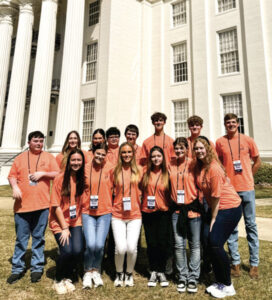

South Alabama Electric Cooperative believes in teaching today’s youth how the electric industry works, equipping them with the knowledge to make informed decisions and develop the leadership skills needed to shape the future.
That is why SAEC selects a group of high school juniors each year to attend the Alabama Electric Cooperative Youth Tour in Montgomery. Students are chosen from schools in the SAEC service area of Pike, Coffee, and Crenshaw counties and receive a free trip to Alabama’s capital city. This enriching experience includes visits to historic sites, as well as the chance to speak with elected officials, participate in team-building activities, and meet students from around the state.
From the group selected to travel to Montgomery, SAEC will choose 2 students to also attend the National Rural Electric Youth Tour in Washington, D.C., in June.
The deadline to apply for the 2025 Montgomery Youth Tour is December 13.
Interested? Here’s how to apply:
The 2025 Montgomery Youth Tour will be from March 11 through 13.
A panel will review all applications and conduct interviews in January to select the winners.

Will Curtis always loved managing land more than hunting?
In 2000, Curtis started Piney Woods Hunting Preserve. 24 years later, he welcomes people from across the country who stay in the Piney Woods lodge near Troy and pay to hunt his preserve’s land for deer, turkey, and hogs.
“They’re able to hunt well-managed land,” Curtis says. “It’s a place where they can go hunt and not have to do all the upkeep or anything. They just show up to hunt. Basically, all the hard work in the offseason, such as food plots and stand work and that kind of stuff is done.”
In Pike and surrounding counties, preserves like Piney Woods provide hunters with places to sleep, meals, and even transportation to hunting sites. Patrons don’t have to worry about anything but the hunt itself.
“We can wine and dine them as much as they want, or they can come for just a hunt and leave,” says John David Taylor, who started Covey Point Outfitters in Goshen in 2021. “We try to make sure we go above and beyond to make sure everybody has a good time.”

Hunting is huge in Alabama. It is part of the state’s culture, yes, but it also makes a big economic impact. Hunting license fees alone add up to millions of dollars in revenue.
For the 2023 through 2024 season, the state issued 161,863 hunting licenses, including both all-game and small-game licenses, according to numbers from Alabama’s Department of Conservation and Natural Resources.
Those figures don’t include people exempt from purchasing regular hunting licenses — those under the age of 16 and Alabama residents aged 65 and older. Also, Alabama resident landowners and their immediate family members do not need regular hunting licenses to hunt their own property.
Nonresidents can buy a 3-day hunting license, a 10-day hunting license, or an annual license. Last season, nonresidents purchased 18,987 3-day licenses, another 3,724 10-day licenses, and 15,663 annual licenses.
An Alabama resident can currently buy an all-game license, which includes turkey and deer, for $33.55. The price goes up if a hunter buys separate licenses for hunting feral hogs and coyotes at night or for hunting with bait. For non-residents, the price for an all-game license can run from $169.55 for a 3-day hunt, $240.40 for a 10-day hunt, and $389.40 for an annual license.

While local hunting preserves and lodges get a fair amount of business from Alabama residents, many of their guests come from out of state. Outfitters also see repeat customers each year.
“We have an elderly couple that comes from Tennessee – they’re in their mid-70s,” says Stephanie Ferguson, of Racknine Outdoors, which has operated in Alabama since 2007. “They are the biggest hog hunters that you have ever seen in your life. When we take them out, they go out at like 5:30 in the afternoon, and they don’t want us to pick them up until 7 in the morning, and they take all their meat home.”
Most of Racknine Outdoors’ hunting land is within a 10- to 20-mile radius of its lodge near Banks.
Racknine, which also hosts hunts in Kentucky, offers an early deer hunt in Alabama after Thanksgiving but doesn’t schedule additional hunts until January when deer become more active.
Ferguson says out-of-state hunters come to Alabama when their own states’ seasons are closed. And the fact that they don’t have to manage the land appeals to guests. Inquiries into hunts come from all over, she says.
“In the last month, I’ve had several from Michigan, Indiana, Pennsylvania, Tennessee,” Ferguson says.
Private hunting lodges typically offer all the amenities of a home, although guests are expected to share rooms. Packages vary in cost and can typically be found on outfitters’ websites. Along with state rules on game hunting, most private hunting preserves have their own rules about what game guests can shoot. For example, with deer, it’s usually larger, mature bucks. Lodges also vary on how many people can hunt at 1 time.

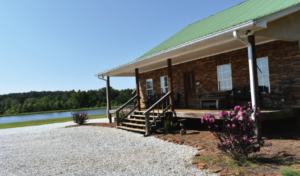
Piney Woods Lodge is located near Troy, but visitors get access to land in Pike, Bullock, and Montgomery counties for hunting. At the lodge, guests can fish in a large pond. Chairs and benches line the front porch so guests can relax while taking in the surrounding landscape. Inside, a small kitchen, dining area, and den make up the main room. A hallway leading to another sitting area is filled with photos of hunters who have visited Piney Woods.
“We get a broad base of hunters,” Curtis says. “We get really experienced hunters that hunt really hard back home, and then we also get people that just come here once a year and that’s the extent of their hunting.”
At Covey Point near Goshen, hunters visit for quail, pheasant, duck, hog, and deer. Bird trips use pointers and other breeds of hunting dogs to flush and retrieve birds.
About 3/4 of Covey Point’s property runs along the Conecuh River. At the Covey Point Lodge, guests have access to a kitchen, living room, full dining room, a game room with a pool table, bedrooms, and an outdoor kitchen.
But with fair chase hunting preserves like Racknine, Piney Woods, and Covey Point, there are no guarantees a hunter will go home with anything.
“Only God knows who’s going to be the lucky winner,” Ferguson says.


A joint effort by South Alabama Electric Cooperative (SAEC) and Troy Bank and Trust is helping to make a 188-acre industrial park in Brundidge more attractive to businesses.
While several companies have looked at the North Industrial Park, none have chosen the property. Growing Alabama funding, however, could make the tract more appealing by getting it “shovel-ready” for prospective businesses, Brundidge City Manager Willie Wright says.
Growing Alabama allows eligible taxpayers to donate to economic development projects and receive a tax credit equal to their contribution. Eligible projects include site preparation of public land for industrial use and infrastructure improvements to existing industrial properties. The project site in Brundidge is currently all timber.
SAEC General Manager David Bailey says that as a cooperative, community involvement is 1 of SAEC’s basic guiding principles.
“This project with the city of Brundidge is a perfect example of that involvement,” he says. “Brundidge is a very important partner in our community. These funds will provide the city with the opportunity to grow their business environment. With the growth in businesses in our communities, it provides jobs for our local citizens. When businesses and jobs grow it improves our local school systems. I think in the end, the citizens of our communities want their families to have the opportunity to stay in our local communities. Growth in business is a way for families to stay local.”
Bailey says it is also important to note that the funds used in this project were going to be dispersed to the state of Alabama, but state representatives had the foresight to develop the Growing Alabama program, allowing local businesses to use tax dollars they would otherwise pay to the state to bene t local communities.
“South Alabama Electric is honored to partner with Troy Bank and Trust to be a small part of this program,” he says.
PowerSouth Energy Cooperative, the Andalusia-based wholesale electric provider, does not qualify for the tax credits, but it helps identify projects for its member cooperatives like SAEC. Of the $15.5 million allocated for Growing Alabama earlier this year, $6.1 million will go to projects PowerSouth helped find in communities within its territory including the Brundidge project, says Caleb Goodwyn, who oversees community development and nance for PowerSouth.
Since 2021, when public utilities were first able to participate in Growing Alabama tax credits, cooperatives have supported projects worth more than $8.9 million. In that time, the value of SAEC-driven projects is nearly $2.7 million.
“The greatest benefit is it’s a way for them to redirect a portion of their taxes to an area that they serve or an area that another co-op serves,” Goodwyn says.
SAEC has contributed to other Growing Alabama projects, but this is the first such project that Troy Bank and Trust has done, says Troy Bank and Trust Marketing Coordinator Meredith Welch. e bank hopes to do more, she says.
“We see it as a way to help the community and provide an incentive for businesses to come in and help the city of Brundidge grow,” Welch says.
Jeff Kervin, president and CEO of Troy Bank and Trust, says the financial institution is proud of the partnership with SAEC and Brundidge and the investment in the North Industrial Park project.

“This project aligns with our mission of generating economic growth and opportunity in our communities and will allow the city of Brundidge to continue to grow and prosper,” Kervin says. “Troy Bank and Trust has enjoyed a long relationship with the city of Brundidge and we look forward to continuing that relationship for decades to come.”
Brundidge Mayor Isabell Boyd and the city are thankful for the commitment shown by SAEC and Troy Bank and Trust.
“1 thing about Pike County, we try to work together to help each other grow, and it means a lot to her and to the citizens of the city of Brundidge to see the communities come together to make a better Pike County,” Wright says.
The Alabama Department of Commerce administers the Growing Alabama program, but the Renewal of Alabama Commission approves applications. A total of $23 million is available under the Growing Alabama program this calendar year. The annual amount available is set to increase incrementally up to $35 million by 2028.


Twice a year, bluegrass musicians and fans arrive at Ole Rex’s Pickin Park in the small community of Henderson. Campers set up in the allotted RV spaces surrounding the covered stage that’s attached to what was once a 1-room schoolhouse. In time, the instruments come out — guitars, fiddles, banjos, and upright bass — as campers host their own jam sessions off-stage.
People have met, married, and brought their kids back to the biannual Henderson Jamboree, held the second weekends in April and October. The next jamboree will be October 11 through 13.
For 48 years, Rex Locklar hosted the event. He died in 2014 at the age of 87. A few miles from the park, a road sign marks Pike County Road 2262 as the Rex Locklar Memorial Bluegrass Highway.
“Everybody loved old Rex,” says Shelby Cargile, 1 of the jamboree organizers.
The atmosphere is like a tailgate party held before a football game, says Rodney Outlaw, 1 of several volunteers who help with the event. Regular attendees have even learned where to go for the best food.
“There will be a tailgate party over there — jammers eating, jamming,” Outlaw says. “ There will be 1 over here — eating, jamming, fellowship.”
Gatherings at what is now known as Ole Rex’s Pickin Park started when Locklar returned from service in World War II. e Locklar family owned the land surrounding the old schoolhouse and purchased the building when the school relocated to Goshen. Locklar began hosting square dances on Saturday nights. Pike County native Hank Williams Sr. even performed in Henderson.
Things shifted to bluegrass in 1965, and it grew from there.
“We’ve got people that plan their vacations for this bluegrass event,” says Wiley Locklar, Rex’s younger brother.
There were those who feared that the death of its founder would mean the end of the Henderson Jamboree. But 10 years after Rex Locklar’s passing, the jamboree is still going strong. It is his legacy and shows the impact he had on others, Cargile says.
Bluegrass musicians Amanda Cook, Brandon Bostic, and Carolyne Van Lierop-Boone have all performed at the Henderson Jamboree and gone on to successful recording careers.
A stone monument sits near the stage. There’s a photo of Locklar and lyrics from a song he wrote titled “Plain Ol’ Country.” Before Locklar died, he shared the lyrics with Cargile.
Over the years, larger venues have offered to take over the event — as long as it moves from Henderson.
“You can’t take Rex’s name over yonder and try to move this and think it’s going to work, because it ain’t,” Cargile says. “Rex’s legacy is right here.”
For more information on the Henderson Jamboree, visit the Ole Rex’s Pickin Park page on Facebook. The park is located at 236 County Road 2262. Walk-ins are welcome during the jamboree. There’s a charge for using the campground, but otherwise, admission is free.

South Alabama Electric Cooperative has been recognized by Touchstone Energy as a member cooperative that received 1 of the top 5 scores in member satisfaction for energy utility services among all cooperatives participating in a quarterly measurement.
In the second quarter of 2024, SAEC received an American Customer Satisfaction Index (ACSI) score of 89 on a 100-point scale.* SAEC’s score is higher when compared to publicly measured cooperative utility scores reported in the syndicated 2024 ACSI Energy Utility Study. The score places SAEC 15 points higher than the average investor-owned utility score of 74, 14 points higher than the average municipal utility score of 75, and 11 points higher than the average cooperative utility score of 78.
“We are proud of the ACSI score, but we are always trying to improve our service to our members,” SAEC General Manager David Bailey says. “The employees of South Alabama Electric Cooperative work hard, and it’s wonderful to see those efforts reflected in such a score. Our members come first under our core values as an electric cooperative as well as a Touchstone Energy member. We try to support our members and our communities in everything we do as a cooperative.”
SAEC was 1 of 18 member cooperatives around the country, including 3 in Alabama, recognized by Touchstone Energy. The 5 highest scores for the second quarter measurement ranged from 89 to 93.
The ACSI measures customer satisfaction in products and services for U.S. industries and economic sectors — government, health care, energy utilities, restaurants, manufacturing, and more. The public and private sectors use the index to improve customer satisfaction and loyalty.

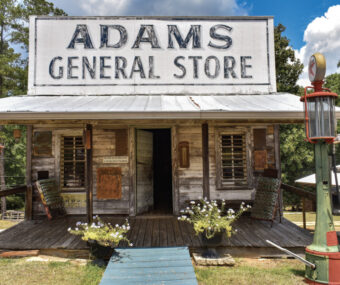
As vehicles on U.S. 231 speed past just outside its gate, the Pioneer Museum of Alabama in Troy gives a peek at history to those willing to slow down a bit.
Over its 53 years, the museum has hosted school field trips, self-guided tours, family excursions, and annual events aimed at bringing history alive. These include the upcoming Pioneer Days, scheduled for October 11 through 12.
“When we start talking to the kids, what I like to get them to realize is that not everybody that came before them had it as easy as they do now,” museum director Barbara Tatom says. “They get to go in the cabins that seven or eight people may have slept in. There’s no bathroom in it. They see an outhouse.”
Visitors learn how people lived before the days of the internet, Google searches, social media, and even World Book encyclopedias, Tatom says. They get a taste of how pioneers subsisted, how they grew or raised what they ate, how they only had 2 or 3 sets of clothes, and how they used everything they could — dresses made from flour sacks, quilts made from scrap cloth, and hats made from corn husks.
“The people before us were very creative,” Tatom says. “They were very ingenious with the stuff that they did.”

Opened in 1971, the Pioneer Museum of Alabama was founded by Curren and Margaret Farmer. Curren, a native Virginian but Troy resident from childhood, worked at what was then called Troy State University. Margaret was an author and historian. Curren led the museum as its director for more than 20 years.
Historic structures located on the grounds include a dogtrot-style cabin built around 1830, as well as a tenant farmer’s house typical of the area. There is an old wood chapel, a schoolhouse, a grist mill, a general store, and a railroad depot. A steam engine and sawmill debarker are also among the items on site.
An 1881 logging locomotive sits out front, donated to the museum in 1992 by the McGowin family of Chapman.
The Locklar Rolling Store is the most recent addition to the museum. The store, built on a bus chassis, was operated for 47 years by Ceciel and Faye Locklar after Ceciel’s parents had run the store for eight years. The Locklars, who closed the rolling store in 2002, carried groceries and household supplies to rural areas, selling them to customers who didn’t have transportation to go to a traditional store. Similar rolling stores operated in Alabama as early as the 1920s.
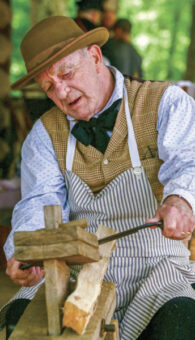
The museum’s main building houses collections that reflect the lifestyles common in Alabama from the state’s pioneer days through World War I. Rooms are set up to replicate the furnishings and styles of the times. Several are filled with furniture donated by Annie Cloud Bass of Brundidge. Museum displays include the office and bedroom suite of former Gov. Charles Henderson, a Pike County native who served as Troy’s mayor before becoming governor.
There are displays of textiles and quilts, including two historic weaving looms. Exhibits feature a replica of a pioneer kitchen — complete with creaking wood floors. Other exhibits focus on the history of Native Americans and the Civil War, the Spanish-American War, and World War I. Blacksmithing, logging, construction, and farming are the focus of other installations in the main building, which also includes a display of carriages and wagons. An indoor mural depicts the old Troy Depot and Hotel Troy. The main building features original artwork by Mose Tolliver, Robert Windham, and Jean Lake.
Events are also a big part of the Pioneer Museum of Alabama’s mission.
Pioneer Days feature demonstrations on blacksmithing, candle making, rope making, woodworking, spinning, Dutch oven cooking, and more. The next Pioneer Days will be October 11 through 12. On December 13 through 14, the museum will hold its Ole Time Christmas celebration.
In the spring, the museum hosts Thunder on the Three Notch, a reenactment of events during the Creek War of 1836- 1837.

These events and the museum exhibits not only preserve pieces of history but help visitors appreciate the times we live in currently, Tatom says.
“Every generation builds upon the last, and we see how things were built upon to get to our generation,” she says.
Tatom says she’s proud of the Pioneer Museum and how it has evolved in recent years.
“You’re going to be surprised at what you see in here,” she says. “I just think every day how incredibly fortunate we are that Mr. Farmer had the vision in the late ’60s that he did about a museum because all of this stuff could be in a landfill somewhere.”
The Pioneer Museum of Alabama is located at 248 U.S. Highway 231 in Troy. Visit pioneer-museum.org for more information and admission rates.
The museum’s current hours are Thursday through Saturday, 9 a.m. to 5 p.m. The hours will be 9 a.m. to 4 p.m. from November 7 to March 8. The museum will be closed the week of Thanksgiving and from December 23 to January 4.
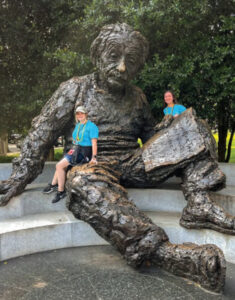

For 17-year-olds Savannah Edgar and Joy Schwarte, the National Youth Tour in Washington, D.C., was a chance to visit national monuments, historic locations, and museums. They learned about history and themselves.
The students represented South Alabama Electric Cooperative (SAEC) during the National Youth Tour from June 17 through 23, joining 1,600 high school students from 44 states.
Hosted by the National Rural Electric Cooperative Association, the annual tour brings high school students to Washington, D.C., for a week-long learning experience. Students also select 1 youth to represent their state on NRECA’s Youth Leadership Council, whose members spend the next year working with cooperatives in their state and the national association.
Schwarte, a senior this year at Pike Liberal Arts School, was 1 of 3 students from Alabama in the running to represent the state on the National Youth Leadership Council. She and the other finalists gave speeches before their Alabama peers, who then voted. While another student was chosen, Schwarte says being a finalist was an honor.
“It was such a great opportunity,” Schwarte says. “I definitely learned more about public speaking and making friends and connecting with people. I feel so much more prepared for the next time that I have an opportunity to run for a leadership role. I’m thankful that I got to experience that with such great friends and with such great kids my age who were so open to learning more about each other and making deeper relationships.”
Edgar, who is entering her senior year at Highland Home High School, had intended to study graphic design. However, after the tour, she is now considering a career in communications, especially after talking with D.C. interns and learning that many of them majored in communications.
“I’ve kind of always known what I wanted to do,” Edgar says. “I’ve always been like, ‘Yes, I’m going to do this.’ But, coming up here has given me the option to actually explore options and see what all is out there, what all I can do in the future.”
Edgar says a career in communications appeals to her. She enjoys building relationships with people and she says she loved meeting different people during the National Youth Tour and learning about their lives.
“I just feel like that it is a career path that would kind of be a little more suited to me because it has everything I’ve always wanted to do in like 1 area,” Edgar says.
The goal of the National Youth Tour is to educate youth about how government works, help them become leaders, and give students a better understanding of cooperative principles and the value of rural electrification.
The National Youth Tour was inspired by a 1957 speech from then-Senator Lyndon B. Johnson during the National Rural Electric Cooperative Association’s annual meeting. The future president suggested sending youth to the nation’s capital so they can see for themselves what the American ag represents. The idea grew each year with cooperatives from different states sending youth to the nation’s capital. In 1964, the NRECA organized joint activities between states. 400 students from 12 states attended the first coordinated youth tour.
Sites visited this year included the Smithsonian Institution, Mount Vernon, the Lincoln Memorial, the Franklin Delano Roosevelt Memorial, and Ford’s Theatre, the site of President Abraham Lincoln’s assassination. A visit to the Capitol was also a popular stop.
As 1 of Alabama’s finalists for the Youth Leadership Council, Schwarte participated in a wreath-laying ceremony during a visit to the Tomb of the Unknown Soldier at Arlington National Cemetery. The visit to Arlington was eye-opening, and she says she is more grateful now for those who have lost their lives defending America and its ideals.
“It was an opportunity for me to just stop and be thankful for everybody who died for our country,” Schwarte says.
Other sites Schwarte found inspiring included the Lincoln Memorial and the United States Holocaust Memorial Museum. Both Schwarte and Edgar loved the visit to the Capitol building and were in awe of the architecture, as well as the magnitude of effort it takes to run the nation’s government.
“There’s so much detail that goes into any of the architecture up there,” Edgar says. “There’s a new detail every single place you look. I feel like every single building up there tells a story, and you really just want to learn more about it.”
Schwarte encourages local students to apply for the Youth Tour program, and, if chosen, to use the experience to learn as much as they can.
“Don’t let any moment pass by where you don’t learn something,” she says. “There’s so much more than history to learn. Go in with the attitude of I want to learn more from the people that I talk to and the places that I see and the speakers that speak to us. You get so much more out of it when you’re really intent on learning something.”