
Font Size:


 Managing your electric bill has never been easier or more convenient. You’re in charge — from viewing your daily usage, to paying your bill online and even choosing to receive bill pay reminder texts.
Here’s a step-by-step guide on how to set up your online account:


If you are a new customer and haven’t received your first bill, you will not be able to set up an online account until the first bill is generated with a statement ID number.
Note: If you are a prepaid billing customer, you will need to call our office for assistance to setup up your online account.

 Most people see the range of someone’s life and notice the dates at the beginning and the end. They think of how long or short that life was, what the world was like when that person entered it and how it had changed by the time they left. But when Jessica Madison looks at her father Nathan Madison Jr.’s life, from his birth in 1950 to his passing earlier this year, her focus is on what’s in between.
“For me, the most important part is that dash between the years because that’s where the work is,” she says. “And my dad had an amazing dash.”
Known as “Junior” to his colleagues and friends, he was recognized throughout the community for his job at South Alabama Electric Cooperative. To him, it was part of his calling to serve people and help out wherever he could.
“People were always saying, ‘That’s the light man.’ That was how he was known out in the community,” Madison says. “Even people I didn’t know who knew him were always telling me about how he helped them with this or did that.”
That was exactly how his fellow lineman Dewayne McGhee knew Junior before joining the cooperative. McGhee first saw Junior when the veteran lineman would come to his parents’ house to restore power. When McGhee graduated high school in 1989 and was working as a substitute bus driver, Junior approached him about working at SAEC. Since then, McGhee has put in more than 30 years with the cooperative and risen to the role of construction foreman.
“The biggest thing I learned about Junior over the years was that he didn’t just want to come here to live and die,” McGhee says. “He wanted to make an impression on somebody else and leave his legacy for someone else to go on. And that’s what he did.”

Junior joined SAEC in 1972 after two years of service with the U.S. Marine Corps in Vietnam and a stint at Luverne Slack Factory. His first job was on a construction crew in Troy before he became an assistant to Serviceman Ed Stroud in Crenshaw County.
The 2 of them were responsible for outages, bill payments and just about any member issues that might come up in the area. And, because the cooperative didn’t have much in the way of formalized training at the time, Junior had to be a quick study.
“Back then most of what Junior learned and his knowledge of how the system worked was picked up on the job. He really had to apply himself to learn everything and how to work with electrical equipment safely,” says former General Manager Max Davis. “In fact, he was way above average in learning the business and looking at problems from other people’s standpoints.”
Years later, when Stroud retired, Davis had no doubts about who should fill the position.
“I think Junior would have been successful in any business. But being in a cooperative, where your members are the real reason for being there, Junior’s success was just automatic,” says Davis. “He had a way of calming people down and working through whatever issue they might have.”
In the early 2000s, those skills earned Junior another promotion to general foreman, where he was responsible for managing the cooperative’s right-of-way operations, overseeing contractors and continuing to work face-to-face with members across the whole system. But no matter how his responsibilities changed, he always maintained his dedication to helping others at every opportunity.
“He listened to people and would always help them, even if it wasn’t explicitly part of his job,” says General Manager David Bailey. “Those are attributes that are not as prevalent as they used to be 40 or 50 years ago. I always said he had a servant’s heart.”
One of Junior’s favorite ways to help others in his community was by opening doors to opportunities at the cooperative. He always encouraged new graduates to join the SAEC team, just as he did for McGhee, and would put in a positive word for candidates he knew would be a good fit.
“Many of the employees at SAEC today were based on recommendations from Junior Madison. Sometimes I’d ask him if he knew someone who applied and he’d always say yes because he knew just about everybody,” says Davis. “He was really interested in having young people from our community join the co-op because it was a good job.”
His advocacy for others didn’t stop there. Junior was dedicated to giving the linemen around him the training he didn’t have starting out. Over the course of his career he personally trained more than half a dozen linemen, including Jeffrey Eiland, Tony Greer, James Horn, Billy Ray Lester, Jason Sipper, Jeff Wilkerson and Jay Adair. Many of them have since gone on to serve in leadership roles at the cooperative or achieve A-class lineman status.
In honor of those achievements, SAEC recently announced it will be offering the Nathan Madison Jr. Electric Lineman Scholarship each year to send an aspiring minority lineman to a lineman apprentice school.
“That’s an imprint on life when you have something that remains after you. Not everybody leaves this world with their name attached to something in it,” says Madison. “It’s a testament to my dad, his hard work and the impact that he made that people recognize it.”
She was especially moved that SAEC General Manager David Bailey, Office Manager Mark Hill and Manager of Accounting and Finance Elizabeth Stough were able to visit her father the day he passed away. Bailey told Junior about the scholarship and the legacy he would leave behind.
“For that to be something he was able to hear and understand on Earth before he left really was a lot for me,” says Madison. “I feel like it was something that probably helped him to release. To realize his work was done is a beautiful thing to me.”
For all that Junior Madison gave to the cooperative and his community, members of his family were also asked to give of themselves. Born after her father started working at SAEC, Jessica Madison says it will be strange not having that constant connection to the cooperative.“I don’t have a memory of my father where SAEC is not involved,” she says. “Where we didn’t hear the radio going off while he was on call, or have a truck of some kind in the yard. We knew how much he loved it.”
No one understands that connection to the work better than the people who did it with him. McGhee also recognizes the sacrifices it required of the other people in Junior’s life.
“I’m thankful to his family for letting us as a brotherhood here at the Cooperative have the time that we got to spend with him,” he says. “SAEC was his heart, it was what he loved, and this was where he wanted to be. So I want to thank them for letting us borrow the time that we did have with him.”
As challenging as those late-night departures and long hours may have been, Madison has no doubt it was all part of her father’s calling. Watching him, she and her sisters learned everything they needed to know about serving their community and putting their faith into practice.
“Getting those calls at 2 in the morning was just something he lived for in a way that I can’t even comprehend myself,” she says. “It was how he tended to the community. Giving them a word, speaking to them, sharing with them, buying them food, whatever it might be. He truly had a servant’s heart. It wasn’t just a job to him. He knew he was going to touch somebody’s life in some way just by being there.”

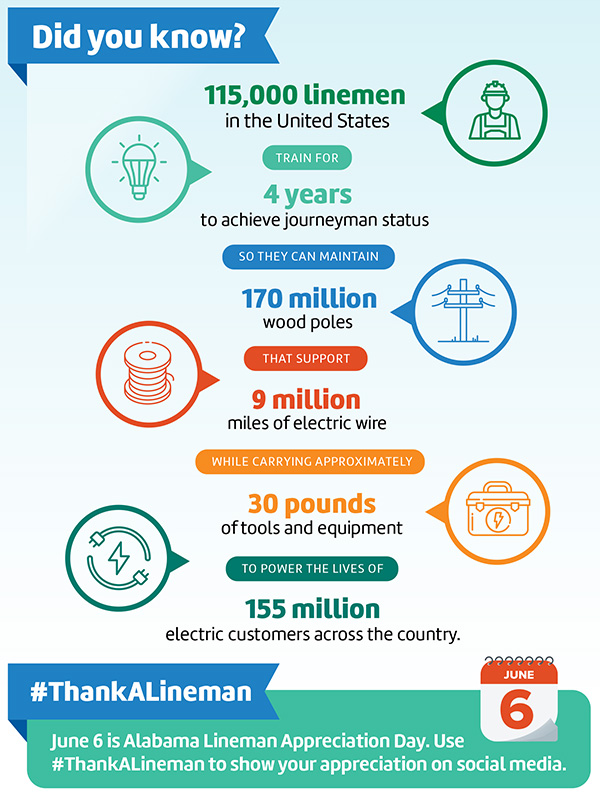
Many of us don’t think about the work that goes into powering our homes. We’re so used to having electricity in our daily lives that we simply flick a switch and trust that the lights will come on.
That convenience wouldn’t be possible without lineworkers who work hard all day and are willing to roll out of bed and leave their families at night to make emergency repairs. Their job can be dangerous, but they step up without complaint, even in the wind and rain.
That’s why one day isn’t enough to say thank you. The next time you take a hot shower in the morning, turn on the TV at the end of a long day or power up your phone to keep in touch with loved ones, remember that it’s all thanks to lineworkers.

 April is Safe Digging Month across the state of Alabama, and it’s easier than ever to put safety first on your next home project.
Digging without first checking for underground utility lines not only runs the risk of interrupting service to your home and for your neighbors, but it can also result in serious personal injury. Many utility lines are buried just a few inches below the ground. So even if you’re only planning a small gardening project, it’s important to call before you dig.
If you plan to dig on your property, protect yourself and your community by following these simple steps:


 While SAEC’s rates don’t go up during the summer, a higher than expected bill can make it feel like they have. But by making a few changes around the house, you can keep cool without sweating your bill.
A spot in the shade — Keep blinds and curtains closed during the day to keep sunlight from heating your home. Open them back up in the evening when the temperature cools off.
Light things up — Traditional incandescent lightbulbs waste energy on heat. Upgrading to more efficient LED bulbs will keep your home cooler and save you money throughout the year.
Your biggest fan — Run a ceiling fan counterclockwise to cool a room down. If you don’t have a fan in your home, a portable fan can provide a nice breeze just as well.
Get your grill on — Stoves and ovens can raise the kitchen temperature by 10 degrees. Cooking on the grill outside keeps your home cool while you enjoy the summer sun.
Clean and cool — Most energy used when washing clothes is from heating the water. Use cold water instead to lower your electric bill, and air-dry clothes if the weather is right.
Hot tech — Be careful where you put electronics that give off heat like TVs or lamps. Placing them close to the thermostat can fool it into thinking your home is hotter than it is.

For many members, the days of paper bills and sending checks in the mail are a thing of the past. Even finding the time to sit down and log in to their account on a computer can be a challenge.
That’s why we created the SAEC app. With just a few taps, members can have access to the cooperative anytime, anywhere.
 Access your account — See all of your account information and manage account settings on the go.
Download the SAEC App from the App Store or the Google Play Store today to get the full power of your cooperative in the palm of your hand.

 The coming of spring brings longer days, warmer weather and blooming flowers. But when temperatures change it can also signal the arrival of severe weather season. Planning ahead before a storm strikes can help keep you and your family protected and ensure everyone knows what to do in an emergency situation.
Fortunately, planning ahead doesn’t have to be complicated or expensive. Just keep a few tips in mind before, during and after the storm.

 Amy Garrett was there on Day One, when Pike County Schools started its STEM Academy 7 years ago. She knows how far the program, named for its focus on science, technology, engineering and math, has come.
“We started from nothing. We had, literally, nothing: some cardboard and some tape,” says Garrett, who was the teacher hired for the academy’s inception. “It’s amazing to me to see what they’ve been able to attain for us in seven years so that these kids are being exposed to so many different things.”
Garrett now teaches fifth and sixth graders, but she taught all participants in the academy at the beginning, which originally was for fifth through the eighth grade but has since expanded to the ninth grade.
At every level, students are required to solve problems with teamwork, collaboration and critical thinking while learning the engineering and design process, which Garrett notes will be used in everything they do through the entire program.
Fifth grade units include coding, robotics and computer games design. In sixth grade, units are taught on design and modeling, 3D printing, more robotics, aerospace flight and drones.
Goshen High School ninth grader Katelyn Davis says the STEM Academy’s lessons are valuable in or out of class.
“It really takes you out of your comfort zone and shows you the type of person you can be,” Katelyn says. “It shows us how much we can do. We’re not a private school, and we’re not a big school. I feel some people have that kind of victim mentality, that we’re not good enough. But this shows us we can do it. We’re stronger and smarter than we thought we were.”
As crucial as anything, the STEM Academy teaches children to fight through failure. Nobody gets it right the first time — or even the second.
“They are bright kids in this program, and they don’t like to fail,” Garrett says. “They think every time they are assessed on something they should make a 100 or it should work right. There are kids that struggle with that. They hit the wall a little bit.”
Eventually, most work through those frustrating challenges.
“I’ve seen kids grow by leaps and bounds in maturity,” Garrett says. “The cool part is that we can watch them over four and five years — from fifth grade to ninth. When we first started here I had these kids for four years. We didn’t have ninth grade at the time. I taught all of them. To see them progress over those four years is really amazing.
“They pass us so fast,” she says. “I don’t need to know all of the answers, because they’re going to figure it out. That’s the beauty of it — they’ll figure it out.”

 Robotics really is a team sport, and one of the region’s best examples is the Pike County Schools robotics team, which is coming off another outstanding competition season representing the PCS STEM Academy.
That group won the best Robotics competition at Troy University last October and advanced to the regional competition in Auburn in early December.
It was the second consecutive year that Pike County Schools placed first overall in the Troy hub — and the second year students and teachers were dealing with COVID-19 restrictions.
While the actual competition and robot performances were held in person, crucial aspects such as presenting an engineering notebook and marketing the robot were done virtually. “That adds another level of difficulty, because it’s hard to read an audience over Zoom or Teams,” Pike County Schools STEM Academy teacher Kim Sellers says. “It’s harder to present.”
The competition’s theme was “Demolition and Safety,” meaning each school had to design a robot capable of completing various assignments in the area of demolition.
“Troy University gives us a kit of plywood, PVC, some motors and a few other things,” Sellers says. “They give you the theme and tell you to go forth and build.”
Designing, programming and building the robot are challenges enough, but the competition also includes a marketing element where teams have to “sell” their product to judges and investors.
“They have to think through what the cost of the robot would be, how do they handle customer service for it if something malfunctions and answer professional development questions. So if a company bought it, you have to train that company’s employees to use it,” Sellers says. “It’s a wide variety of marketing.”
Pike County High School ninth grader Zane Rigdon had several roles for this year’s competition. He helped build the robot — wood and sanding primarily, he says — but he was also responsible for drawing the dozens of ever-changing ideas on paper.
“It was very stressful,” Zane says. “We had tons of ideas for the base of the robot — if it should have like a claw or an arm. How many wheels should it have, 2 or 4? We thought about making it like a dump truck. Really, almost all of those ideas ended up getting scrapped.
“We had, like, 6 ideas for the PVC alone. Where do the motors go? It changed a lot the entire time. It changed from Troy to Auburn. It kept changing. We even made changes at both competitions.”
Each change would affect other parts of the team. There was a group responsible for documenting each change and why it was being made. The sales and marketing units needed to know about those changes, too.
Katelyn Davis, a ninth grader at Goshen High, has been in the STEM Academy since the sixth grade. She recalls as a seventh grader being pressed into duty on the day of the competition as the lead presenter to the investors.
“I had to make it up on the spot,” Katelyn says, wincing as she recalls the moment.
And yet, she did it. She kept her poise. This year, Katelyn was a veteran on the marketing team, and there were many new faces throughout the program.
“This year, most students were brand new. They had never done the competition before,” she says. “Benjamin Taylor, Sam Bozeman and Bryant Brooks had done it before and were on the driving team. I had to figure out everything for marketing. We had a mentor, a junior, Cane Merrill. They won first place the last time they did it, my seventh-grade year.”
Sellers says the competition is primarily for grades nine through 12.
“We were mostly ninth graders,” she says. “We worked on it in ninth-grade class time. The older kids would come back and meet a couple days a week. They know what worked in the past, but the ninth graders wanted to try their own ideas.
“They had to find that happy medium,” Sellers says. “Kids have to learn compassion and communication. We kind of preach the four C’s: critical thinking, communication, collaboration and creativity. That’s ingrained in them through STEM.”
This year’s team earned a first place at Troy University for web page design and garnered six second-place awards for critical robot design, robot performance, exhibit and informal interview, the BEST Award, marketing presentation and engineering notebook.
Sellers says South Alabama Electric Cooperative has been a valued partner in its support of the Robotics program at the Pike County Schools STEM Academy.
“SAEC has been instrumental in the success this year,” the teacher says. “They’ve given us money, time, even tools. Since we’re given kind of raw materials, we have to form everything. They have donated money to help us purchase tools that were necessary. That saves us time in building. We don’t have to go out and find someone to cut it for us or let us use their machines. They have also trusted us to get the right things we know our students need.
“Also, I didn’t want students having to worry about finding food somewhere,” Sellers says. “SAEC donated money and I ordered box lunches both days for our students. So they’re not just investing in the school and the materials the school uses, but investing in our students, too.”