
Font Size:

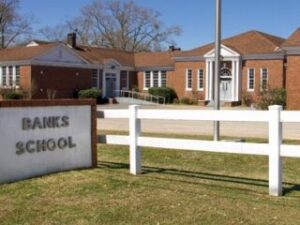
 The old Banks Middle School building was an iconic a landmark in this small Pike County community. The school, which opened in 1937, has been taken down for a newer, bigger Banks School that will accommodate kindergarten through eighth grade on one campus when it opens for the 2022 to 2023 school year.
While the beloved building will be missed, administrators, teachers and parents are universal in their resolve that Banks has been, is now and will continue to be a special place to learn and grow. Banks School principal Shantell Rouse, a relative newcomer as she wraps up her third year, says it “didn’t take long” to confirm that feeling.
“The school is the heart of this community, and the community supports it,” Rouse says. “They love the school. It goes back from grandparents. It’s generation after generation. It’s amazing to see how the community feels about this school. Their response to anything that I need here is just amazing.
“One of the teachers can ask for something and the parents are going to provide it. This year the fifth grade wanted to have their Behavior Day with a Mardis Gras theme. It was amazing what the parents brought in. Field Day, the same way.”
Karen Smith retired after 41 years in teaching — 31 of those in Pike County and the last 27 at Banks. Her husband, Randall Smith, went to school at Banks.
“There are people who moved here just so their children could go to school at Banks. We’re like family — children that you’ve taught, and you taught their parents,” she says. “Over the years when we’ve had these studies done, the only thing parents wished was that it went through high school.”
Laura Ellis is the reading coach at Banks’ Bethel campus —they call it the “little school” because it is home to kindergarten through third grade — and has been at Banks for 29 years.
“This is the hub of the community,” Ellis says. “My daughter was 18 months old when I came to Banks. She’s 30. She had her first Fall Festival in that old building. All the programs and big events we bussed our kids from the little school for every Honors Day, Field Day, everything.”
She noted that Banks is unique in Pike County in that it is a true community school.
“Our parents love the fact that we know the name of every child in this school,” Ellis says. “This afternoon in the car line, I will have former students and grandparents picking up their kids. They laugh at me when I get my walkie-talkie and start calling out names just by seeing the cars. If you’re not from here, you become one of us really quickly.”
 The feelings for the school and its ties to the community seemed to grow even stronger when Banks had a community walkthrough at the old building before its demolition.“I knew that everybody loved Banks,” Ellis says. “But until we had that open house … I still have chill bumps. It was humbling to see how much people loved the school and still loved it. The memories are deep and they’re strong.”
Principal Rouse just shook her head in amazement.
“I had no idea we would have that many people come through here,” she says. “We had over 500 in two days. We did a Saturday morning session and a Sunday afternoon. Saturday was really good, and we just assumed we wouldn’t have that many Sunday. It was just as crowded, if not more.”
Former Banks students brought their families. Rouse said she was glad she was there, but added she didn’t need to be. Former students were happy to take the lead, showing kids and grandkids their old classrooms. One grandfather showed his family where he worked in the cafeteria to pay for his lunch.
“The people were there with their families. This was their building,” Rouse says. “I just sat back and enjoyed watching people take so much pride in going through the buildings and sharing their memories. One couple had been married 50 years. They skipped the junior prom, got married and have been together ever since. It was wonderful.”
The sentiment for the old building was evident. But it was time for something better — and bigger. Rouse says she is eager to have all of Banks School on one campus. The additional classrooms, STEM labs, a Bobcat News Room, choir room and meeting spaces will be even more welcomed by the students and the community.
“Don Renfroe, a former student, said if it’s the best thing for the kids, let it go,” Ellis says. “That’s the way you have to think about it. We’re preparing them for jobs that don’t exist yet. So we’ve got to be able to keep up, at least, with what it is here now.”

 If Tim Sanders ever needs a boost of energy, he recalls how South Alabama Electric Cooperative linemen approach their jobs.
“When they’re called, they put in the work. They are dedicated,” Sanders says. “They inspire me to be dedicated, too.”
Sanders brings that spirit to the South Alabama Electric Cooperative board of trustees as the new District 7 representative. The board approved his selection in April following the recent retirement of Glenn Reeder.
“He’s very humble, and he’s very willing to serve the members of SAEC, which I think is one of the greatest attributes to have in an electric cooperative trustee,” says David Bailey, SAEC’s general manager.
Sanders has a track record of serving his community. A farmer in the northern Coffee County community of Frisco, Sanders is on the advisory committee of First South Farm Credit, a cooperative financial institution that helps rural communities in Alabama, Mississippi and Louisiana. He also maintains a role on the Coffee Baptist Association’s finance committee and is a deacon at Roeton Baptist Church in northern Coffee County.
“I enjoy doing things for the community,” Sanders says. “I have a lot to learn about electric cooperatives, but I want to find ways to help all the members of the cooperative.”
Sanders believes his greatest attribute may be the managerial skills he has developed while running a farm since 1980. He currently operates seven chicken houses, farms peanuts and cotton on about 600 acres of land and owns about 80 head of cattle. The farm also produces its own hay.
A lifelong resident of District 7, Sanders attended Troy University and studied business before going into farming full time. He is married to Cindy, a teacher who retired from the Enterprise City Schools system but who now works on a contract basis for Ozark City Schools. The couple have two daughters, Abbey and Callie, and one granddaughter, Willow.

 Summer is a season when homes can use lots of energy if homeowners aren’t careful. Extremely hot temperatures tend to stress air conditioning units and other appliances, driving up electric bills.
Fortunately, South Alabama Electric Cooperative members can invest a little time, energy and money to generate major savings. Following these tips from the U.S. Department of Energy will help ensure families have enough spending money to enjoy their vacations.

 If you dislike strenuous work, being a lineman isn’t the job for you.
For Jamie Johns, South Alabama Electric Cooperative’s construction foreman, and Blane Senn, SAEC service foreman, the physical nature of the job isn’t an issue. Neither are the weather, the hours nor the time away from family. With nearly 60 years of combined experience, they take the difficulties of the job, and their responsibilities as foremen, in stride.
“There’s only a few of us with this career, and it’s not the easiest job to do,” Senn says. “But we’ve never been afraid of a little bit of hard work.” Both he and Johns took over foreman responsibilities about a year ago.
“Being foreman is a totally different job,” Johns says. “You have to watch everything you do. It’s my job to make sure the work gets done and make sure everyone goes home safely.”
Often working in extreme temperatures and during storms, watching over their crews is sometimes easier said than done. “I’ve been out there with lightning flickering all around, heavy rains, snow and more,” Senn says. “In the end, you know you’ve got a job to do. You get satisfaction from getting someone’s lights back on because you’re filling a need for them.”
They’ve formed strong bonds with their co-workers. “You stay out here long enough, working with these guys day and night, and you become like family,” Senn says.

“We don’t have a bad group of guys working out here with us,” Johns adds.
While both Johns and Senn now have a large, extended work family, that wasn’t always their goal. Johns took a job at SAEC only two weeks out of high school, and Senn joined the SAEC team at age 25.
“I never thought about doing this for a living, I just happened to be the right person at the right time,” Senn says. Seizing that opportunity also helped him meet his wife, Tonya, who was a receptionist at SAEC when the two started dating more than 25 years ago.
There’s always an unexpected element to the work. “The blizzard of 1993 was my first major storm,” Senn says. “It was thundering through the night, and I just thought it was a rainstorm. When I woke up the next morning, I couldn’t see my car in my driveway because it was covered under a snowdrift. The job keeps you on your toes.”
“You don’t ever know exactly how you’re going to do the job until you get there,” Johns says. “You learn something different every day.”
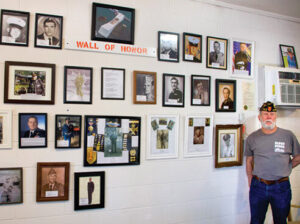
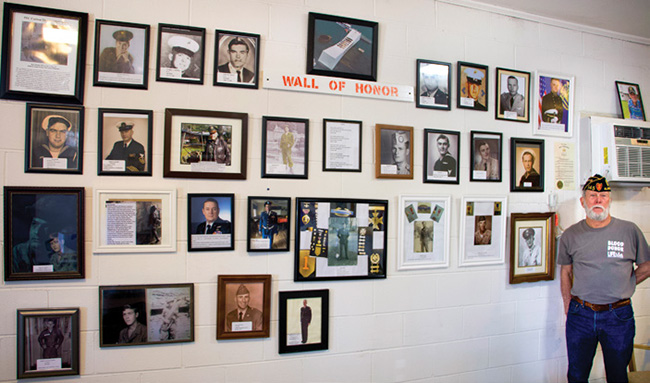
Like American Legion posts across the country, Post 145 in Brundidge is a home of sorts to veterans born and raised in its community, as well as those who have migrated to South Alabama from across the country. 4 years ago, Commander Neil Thrasher decided to start honoring those who had gone above and beyond in service to their country with a Wall of Honor at the post.
“Everyone on that wall has a local connection to Pike County. They may not have been born here, but they lived here, died here, and they served honorably,” says Thrasher, who served in the Navy as a navigational electronic technician on nuclear submarines. “This building isn’t just another Legion post. It’s a shrine to honorable veterans.”
The wall recognizes 30 veterans with local connections, as well as notable veterans throughout history. These include a trio of Medal of Honor recipients: World War I hero Sgt. Alvin York, World War II hero 1st Lt. Audie Murphy and 1st Lt. Robert Howard, an Alabama native and one of the most highly decorated soldiers of the Vietnam War. The top row is reserved for local soldiers killed in action, among them Ensign Joshua Watson of Enterprise, who died in a shooting at Naval Air Station Pensacola in 2019.
“The wall is for veterans who did more than just the average. I made six patrols with the Navy, but I’m not on the wall,” Thrasher says. “A lot of us did our job, but these veterans were exceptional. They gave more than just a day’s work. Most of them gave blood.”
One of the locals honored on the wall is the post’s former commander, Bruel Davis. Davis dropped out of high school to join the Navy during World War II. After the war ended, he finished school and earned an engineering degree before returning to active duty and retiring as a Navy captain.
“He has really been an important leader for this post,” Thrasher says. “Before he took over, this post was used but it wasn’t taken care of. It was a disgrace to veterans. He led the work to get it turned around so it could become what it is now.”
Now 94, Davis’ service to the nation and to his local community has not only earned him a spot on the Wall of Honor, but also a new scholarship fund in his honor that Post 145 may begin offering this year.
Alongside Davis on the wall is 72-year-old Wayne Murphy of Ariton, who earned his spot after serving 2 tours with the Army in Vietnam as part of the 169th Engineer Battalion from 1968 to 1970. Driving a 10-ton military tractor, he would haul equipment, ammunition and even downed helicopters for the 199th Light Infantry Brigade and the 11th Armored Cavalry Regiment.
Murphy gets emotional when he thinks about his photo hanging on the Wall of Honor next to those who spilled blood and gave their lives in service to their country. But as a Vietnam veteran, the recognition means all the more for having been a long time coming.
“When I came home, like most of the Vietnam veterans, we weren’t welcomed back,” he says. “Being on the wall now means so much to those of us who didn’t get the recognition at the time. It’s a blessing to me, and I know it is for many others.”
In addition to honoring veterans themselves, Murphy hopes the Wall of Honor can continue to play an important role for the local community. Post 145 is always committed to supporting local veterans, students and first responders. But Murphy sees something different in people’s eyes when they view the Wall of Honor.
“It just means a lot to the community that they can come by and visit the wall, because these are all local people,” he says. “There have been school classes that have been here and looked at the wall. It makes them glow to see the sacrifice that a lot of these soldiers made.”
While every American Legion post is a mix of locals and transplants, Thrasher hopes the wall will help the people of Pike County better understand the veterans living right next door.
“A lot of the posts in the South do not have a local identity when it comes to their veterans,” he says. “The veterans on the Wall of Honor are all local to the Pike County area. They served honorably and never asked for anything. But it’s important to remember them because so much of that history can be thrown away or lost.”
Most of all, Thrasher hopes the wall can help preserve the legacy of those who have been ready to sacrifice everything in service to their country. “We want to recognize them to make sure the people in this community and throughout the nation never forget,” he says. “That’s a slogan among all veterans, because the worst thing you can do is forget somebody.”

 As an electric distributor, part of South Alabama Electric Cooperative’s job is to make sure our members don’t have to worry about where their power originates. As long as members do their best to pay their bills on time and report the occasional outage, they can count on reliable electric service to their home or business.
When it comes to bringing that power to our system, SAEC is not unlike our members. Just as our members join the cooperative to share the cost of service, SAEC and more than a dozen other electric utilities are members of PowerSouth Energy Cooperative. As members, we purchase wholesale energy from PowerSouth, and that energy is transmitted to our system so we can distribute it to you.
Today, PowerSouth’s energy mix consists of natural gas, 77.2%; coal, 18.9%; hydroelectricity, 3.6%; and other renewables, 0.3%. But with technological advancements, environmental regulations and a new administration in Washington, D.C., change is likely on the horizon. So, PowerSouth is taking steps today to ensure a safe, reliable and affordable energy supply for the future.
“The long-term power supply plan includes implementing cutting-edge technology, construction of a new natural gas generating plant and utility-scale solar project, and the addition of nuclear energy,” says PowerSouth Public Relations Coordinator Josh Richards.
PowerSouth projects that by 2026 its energy mix will consist of natural gas, 77.0%; nuclear, 10.7%; coal, 6.4%; and renewables such as hydro, landfill gas and solar, 5.9%.
One of the biggest changes for our power mix in recent years has undoubtedly been the closure of the Charles R. Lowman Power Plant in Leroy. The first Lowman unit came online in 1969, and the coal plant was a crucial part of this region’s generation resources for more than 50 years.
After a proposed fine for the plant’s disposal of coal ash in 2018, PowerSouth announced that Lowman would close permanently in October 2020. In its place, a new combined-cycle natural gas facility dubbed the Lowman Energy Center will begin generating power by 2023. Once online, it will be able to power more than 300,000 homes annually, adding to the output of natural gas facilities in Gantt and McIntosh, Alabama.
Combined-cycle units use excess heat from powering a natural gas turbine to boil water for a steam unit, capturing energy that otherwise would be wasted. As a result, the Lowman Energy Center will have a significant impact on the overall efficiency of PowerSouth’s generated power.
With the coal plant’s closure, sulfur dioxide emissions have been eliminated and nitrous oxide emissions, which reached their maximum in 2009 at nearly 14,000 tons, will be reduced to less than 2,000 tons a year. At the same time, carbon dioxide emissions will level off at their lowest point in the last 20 years. The new plant will also help conserve water, bringing the average daily usage down from 40 million gallons in 2020 to just 5 million.
In addition, natural gas prices are projected to remain stable, making a combined-cycle plant like the Lowman Energy Center a great option for viable, reliable and cost-effective generation for the cooperative well into the future.
“Construction of the new Lowman Energy Center is now underway,” Richards says. "When complete, the state-of-the-art natural gas combined-cycle power plant will be among the most technologically advanced, efficient and environmentally sound generating plants in the country.”
As reliance on coal decreases, PowerSouth sees nuclear and solar energy playing a larger role in generating power without air pollutants or greenhouse gas emissions. Starting in November of this year, PowerSouth will begin purchasing nuclear power from the Municipal Electric Authority of Georgia.
“Adding nuclear energy to our power supply mix will underscore our ability to supply uninterrupted power to our members at an affordable cost,” Richards says. “Nuclear is a safe and reliable ‘always-on’ power source that promotes diversity in PowerSouth’s energy portfolio heading into the future.”
This energy will be generated from the Vogtle Nuclear Power Plant’s two new units. While PowerSouth will not own the plant itself, it will be able to purchase a portion of the energy its units produce, the first of which will be operational late this year.
Additionally, as consumer interest in renew-able energy has increased, PowerSouth has kept a close eye on the costs of providing a utility-scale solar option to its distribution members. Next year, PowerSouth plans to launch a solar project in partnership with those members.
The project will add up to 80 megawatts of solar-generated energy to PowerSouth’s energy mix. While solar energy is not currently a solution for large-scale generation, the new project will provide enough electricity to power a portion of the needs for more than 13,200 homes.
“While the energy landscape is shifting, our commitment to delivering reliable and affordable power remains unchanged,” Richards says. “The decisions we make now will affect future generations, so we strive to make choices that will ensure we can provide reliable, affordable electricity for years to come.”

Congratulations to this year’s Rural Electric Cooperative Youth Tour students! While the in-person tours were canceled for 2021, South Alabama Electric Cooperative is giving even more support to 10 local students as they continue their education. 8 students will receive a $1,000 scholarship, and 2 will receive $3,000 scholarships in place of attending the Washington Youth Tour.


 No matter where you live or work across the SAEC service area, there’s a good chance Terry Rodgers has helped connect your power. After his 45-year career as a construction and service foreman, Rodgers looks back with gratitude on his recent retirement from the cooperative.
Rodgers started his career at SAEC in 1976, just four days after his 18th birthday, and he’s seen plenty of changes through the years.
“When I started, we had 2 bucket trucks and 2 line trucks. The rest were pickups,” Rodgers says. “It’s changed a lot, but it’s been good to me and my family. I’ve really enjoyed it.”
Other than a short time in lineman school, Rodgers learned through on-the-job-training. Initially starting as a grounds-man, by age 29 he was a construction foreman leading workers throughout the service area. Members of Rodgers’ crew spent their days connecting new residential and business members, and building or rebuilding lines, among other things.
For the last four years of his career, Rodgers worked as the service foreman, which involves connecting and disconnecting meters, troubleshooting, working on security lights and lots of public interaction.
“Terry Rodgers’ knowledge of South Alabama runs very deep. We used that knowledge to help train newer employees and Terry was always willing to teach the new linemen,” says General Manager David Bailey. “I’ve always thought that when Terry told you something about the electrical system, you better sit up and write it down because it’s that important.”
Regardless of the job title or what was scheduled, Rodgers had the same goal each day.
“I tried to send whoever was working with me home just like they came to work,” he says. “It’s a lot of dangerous work, and it just takes one slip-up. I’m proud no one ever got seriously injured on my teams.”
There are very few states across the Southeast that Rodgers hasn’t visited to help rebuild after major storms. The hurricanes were memorable for Rodgers, particularly Opal.
“When it was over, we didn’t have a single meter left turning,” he says of the 1995 Category 4 storm that cut a path of destruction through the heart of Alabama. “It was five days before we got the first substation back up.”
After about two weeks, power was restored with the help of more than 200 visiting linemen. At other times, Rodgers returned the favor, traveling to restore power for communities in need.
“There’s a lot of pleasure in it,” Rodgers says. “When you get someone’s power back on, it makes you feel good about your job. You know you’re making a difference.”
After 45 years of work, it’s not just Rodgers who looks forward to retirement. His wife, Teresa, will also be happy to relax.
“With 2 kids at home, it was just as much of a job for my wife as it’s been for me,” says Rodgers. “Every time I was on call or out of town, she was too.”
Now, instead of worrying about the next big storm, Rodgers will focus on travel, a nice “honey-do” list and his grandkids, and maybe even take up fishing again.
“I won’t miss getting up in the cold weather or the rain,” he says. “But I’ll miss the early mornings drinking coffee together. I’ll miss seeing everyone and camaraderie. It’s been a great career.”

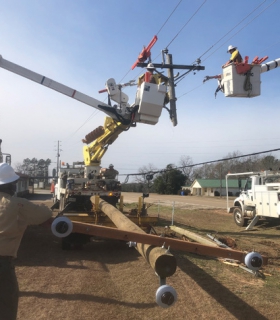 Every car accident has the potential to be dangerous. But when those accidents involve power poles or other electrical equipment, the risk to passengers and first responders can be even greater.
“You can’t see electricity. That’s the biggest danger,” says AREA Safety Specialist Jeff Whatley. “Not all power lines spark and arc when laying on the ground, so you have to assume they could be energized.”
Safe behavior after an accident involving electrical equipment can sometimes be counterintuitive, so it is important for members to understand what to do in case an accident occurs:
Britt Betts, AREA’s training and safety coordinator, also warns that those who may come across an accident involving a power pole need to keep their distance. “Angels always come out when there’s an accident,” he says. “But if you drive up on something like that, even though you want to get out and help, if there are lines down you have to stop yourself.”
When SAEC gets the call that a car accident has occurred involving a power pole, the cooperative turns to its SCADA system. Thanks to remote switching technology, a cooperative employee can immediately cut energy to that section of line before anyone arrives on the scene. After that, safety comes first as SAEC follows the lead of emergency personnel.
“From our perspective, we go by what the first responders tell us,” Betts says. “We’ll de-energize the switches, ground the line if need be and do whatever we need to make it safe for them to get to the vehicle.”
Once everyone has been safely removed and the vehicle has been towed, SAEC can begin repairs on the equipment itself.