
Font Size:

The craft behind stained-glass art hasn’t changed much over the years. There are water jet machines for cutting repetitive pieces or making more difficult cuts, and software makes it easier to resize original designs.
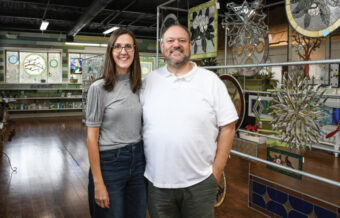
But the art still takes the same hands-on skills David Adams learned from his late father.
“I started doing glass when I was 11,” David says.
At the gallery of Adams’ Glass Studio in Troy, high windows allow natural light to shine through the many stained and beveled-glass creations. Near the front entrance, candy and packaged nuts are sold.
Sam Adams, David’s grandfather, started the family business in 1953 as a roadside pecan stand on Highway 10 in Clio.
U.S. Highway 231 was being expanded to 4 lanes through Troy, and Sam sought to catch the business from the traffic detoured around construction.
The business, first located under a big oak tree not far from the Pea River, did so well that Sam decided to buy land on the completed 4-lane U.S. 231 south of Troy and open a permanent location.
Charles Adams, David’s father and Sam’s son, started the stained glass side of the business years later, making Adams Nut Shop a place where 1 could stop for boiled peanuts, pecans, and artistic glass. Charles taught art at the school in Clio before attending art courses at Troy University, learning kiln-formed glass techniques from the late Troy artist Ed Walter. It was during that time that Charles also learned to make stained glass.
The original store had a nut and candy shop on the top floor while Charles created his glass pieces in the building’s basement. That building burned in 2011 when a pipe slipped loose from a wood-burning stove, spreading fire rapidly through the old building. Fortunately, nobody was hurt, and the family rebuilt the business.
David and his wife, Melanie, worked behind the scenes of the business with Charles until he passed away in 2021. Even since taking over, they still work their other jobs. David has worked for the Retirement Systems of Alabama in Montgomery for 20 years, and Melanie is the secretary at Brundidge Methodist Church. The family attends services at Brundidge Methodist, and it is also home to the first stained-glass window Charles crafted for a church. There are a few part-time employees at Adams’ Glass and 1 full-time employee who has been with them for decades, helping manage things during the week.
But in the evenings and on Saturdays, the couple is at the glass studio.
David and Melanie have 4 daughters, and they hope will 1 day take over. While Melanie worries about losing the glass art craft, she loves how the business has evolved and wouldn’t mind seeing 1 of their daughters help the business evolve more into other art mediums.
Melanie says it means a lot to them when customers who knew Charles visit.
Charles would sit near the front counter and solder like David does now, and customers would come in and talk, Melanie says. Charles could carry on a conversation while soldering, never even looking up.
“People loved him,” she says of her late father-in-law. “It’s neat to see the history, to be a part of something like this.”
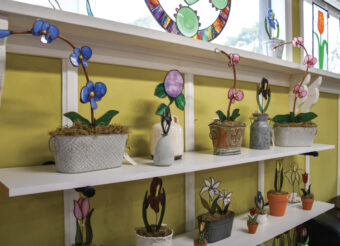
Repeat customers often return to buy gifts, selecting from a collection of stained glass flowers and topiaries, bride and groom cake toppers, crosses, and angels. David can create custom pieces from photographs, although without details of people’s faces. Nativity sets are popular, and customers add to their collections every year.
The studio buys glass in sheets, already colored or in clear textures. The glass is then cut for the custom stained-glass designs. With kiln-fired glass, powders and pieces of glass are heated together to form colors and designs — it’s a form of glass art that David hopes to do more when he retires from his job in Montgomery.
Adams’ Glass Studio uses the same copper foil method of stained-glass art created by Louis Comfort Tiffany in the 19th century.
“With the copper foil, we can get a lot more detailed design,” David says.
Melanie wraps the edges of the glass in the copper foil for David to solder together, using a worn wooden dowel to press the foil to the glass. A chemical agent known as flux is used to ensure the soldering wire adheres to the copper foil smoothly and creates a strong bond between the glass pieces.
The glass art industry and tools have evolved, David says. Glass is more expensive, and vendors have gone out of business. After the 2011 fire destroyed the Adamses’ original hand-drawn designs, David used software to recreate them from photographs. The software also made resizing designs a lot easier. The craft, David says, still requires a human touch.
“Glass is just an unforgiving medium if you don’t have the right touch,” he says.