
Font Size:

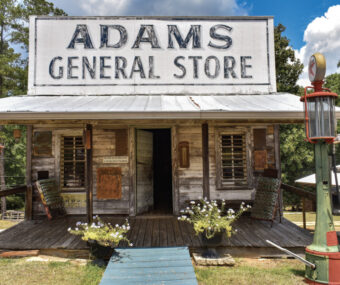
As vehicles on U.S. 231 speed past just outside its gate, the Pioneer Museum of Alabama in Troy gives a peek at history to those willing to slow down a bit.
Over its 53 years, the museum has hosted school field trips, self-guided tours, family excursions, and annual events aimed at bringing history alive. These include the upcoming Pioneer Days, scheduled for October 11 through 12.
“When we start talking to the kids, what I like to get them to realize is that not everybody that came before them had it as easy as they do now,” museum director Barbara Tatom says. “They get to go in the cabins that seven or eight people may have slept in. There’s no bathroom in it. They see an outhouse.”
Visitors learn how people lived before the days of the internet, Google searches, social media, and even World Book encyclopedias, Tatom says. They get a taste of how pioneers subsisted, how they grew or raised what they ate, how they only had 2 or 3 sets of clothes, and how they used everything they could — dresses made from flour sacks, quilts made from scrap cloth, and hats made from corn husks.
“The people before us were very creative,” Tatom says. “They were very ingenious with the stuff that they did.”
Opened in 1971, the Pioneer Museum of Alabama was founded by Curren and Margaret Farmer. Curren, a native Virginian but Troy resident from childhood, worked at what was then called Troy State University. Margaret was an author and historian. Curren led the museum as its director for more than 20 years.
Historic structures located on the grounds include a dogtrot-style cabin built around 1830, as well as a tenant farmer’s house typical of the area. There is an old wood chapel, a schoolhouse, a grist mill, a general store, and a railroad depot. A steam engine and sawmill debarker are also among the items on site.
An 1881 logging locomotive sits out front, donated to the museum in 1992 by the McGowin family of Chapman.
The Locklar Rolling Store is the most recent addition to the museum. The store, built on a bus chassis, was operated for 47 years by Ceciel and Faye Locklar after Ceciel’s parents had run the store for eight years. The Locklars, who closed the rolling store in 2002, carried groceries and household supplies to rural areas, selling them to customers who didn’t have transportation to go to a traditional store. Similar rolling stores operated in Alabama as early as the 1920s.
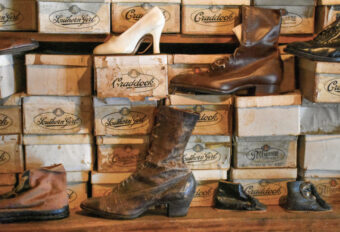
The museum’s main building houses collections that reflect the lifestyles common in Alabama from the state’s pioneer days through World War I. Rooms are set up to replicate the furnishings and styles of the times. Several are filled with furniture donated by Annie Cloud Bass of Brundidge. Museum displays include the office and bedroom suite of former Gov. Charles Henderson, a Pike County native who served as Troy’s mayor before becoming governor.
There are displays of textiles and quilts, including two historic weaving looms. Exhibits feature a replica of a pioneer kitchen — complete with creaking wood floors. Other exhibits focus on the history of Native Americans and the Civil War, the Spanish-American War, and World War I. Blacksmithing, logging, construction, and farming are the focus of other installations in the main building, which also includes a display of carriages and wagons. An indoor mural depicts the old Troy Depot and Hotel Troy. The main building features original artwork by Mose Tolliver, Robert Windham, and Jean Lake.
Events are also a big part of the Pioneer Museum of Alabama’s mission.
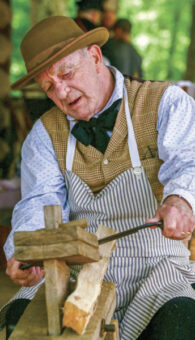
Pioneer Days feature demonstrations on blacksmithing, candle making, rope making, woodworking, spinning, Dutch oven cooking, and more. The next Pioneer Days will be October 11 through 12. On December 13 through 14, the museum will hold its Ole Time Christmas celebration.
In the spring, the museum hosts Thunder on the Three Notch, a reenactment of events during the Creek War of 1836- 1837.
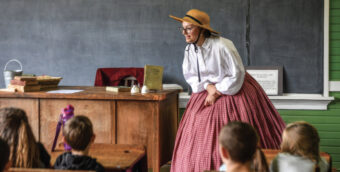
These events and the museum exhibits not only preserve pieces of history but help visitors appreciate the times we live in currently, Tatom says.
“Every generation builds upon the last, and we see how things were built upon to get to our generation,” she says.
Tatom says she’s proud of the Pioneer Museum and how it has evolved in recent years.
“You’re going to be surprised at what you see in here,” she says. “I just think every day how incredibly fortunate we are that Mr. Farmer had the vision in the late ’60s that he did about a museum because all of this stuff could be in a landfill somewhere.”
The Pioneer Museum of Alabama is located at 248 U.S. Highway 231 in Troy. Visit pioneer-museum.org for more information and admission rates.
The museum’s current hours are Thursday through Saturday, 9 a.m. to 5 p.m. The hours will be 9 a.m. to 4 p.m. from November 7 to March 8. The museum will be closed the week of Thanksgiving and from December 23 to January 4.